
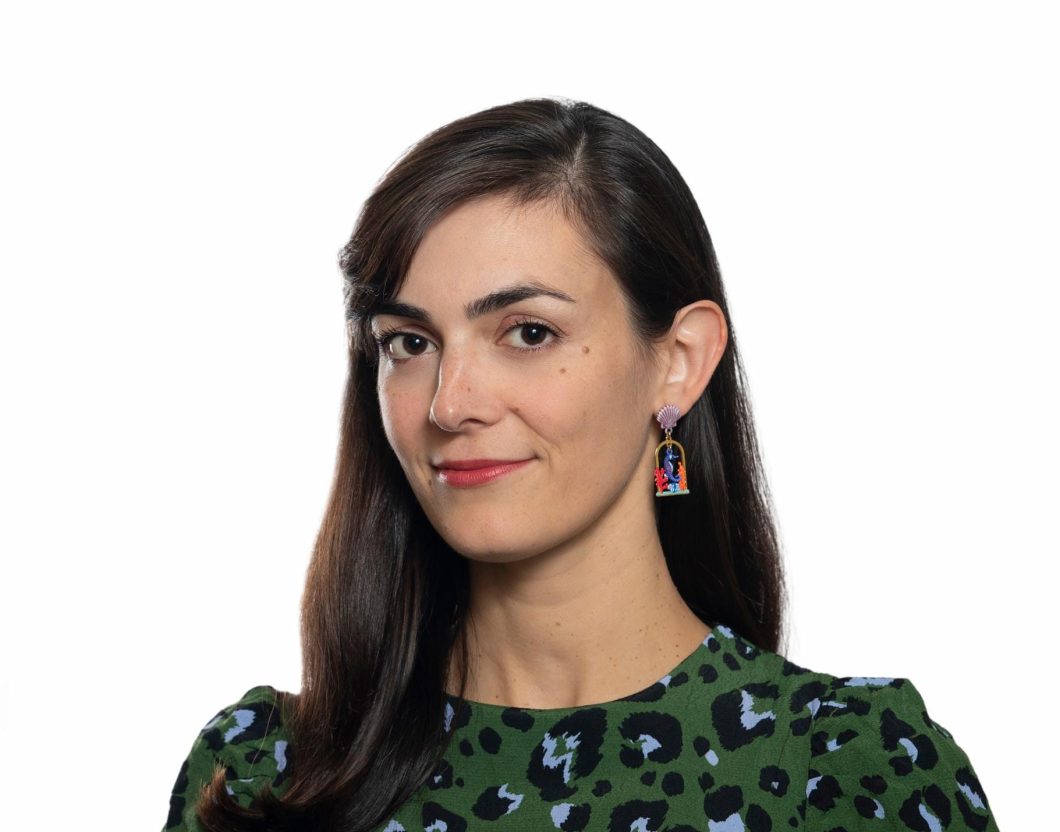
Jessica Hamzelou was no stranger to the fringe side of longevity medicine when she attended The Longevity Summit in late 2023. This burgeoning field, focused on treatments to extend the human lifespan, is awash with unvetted claims, cultlike figureheads, and quirky practices. Earlier in the year, at a gathering of longevity enthusiasts called Zuzalu, she had met folks hoping to create their own “longevity-focused state” and striving to live forever. And at the summit, a clinic director volunteered, unsolicited, that Hamzelou could use some Botox.
But she also encountered a different sort of proponent at the summit: clinicians and researchers trying to establish longevity medicine as a legitimate science. As a reporter for MIT Technology Review, Hamzelou had tracked the field for a while, and that push for credibility—coupled with a rise in funding and consumer interest—felt new.
So Hamzelou sought out a range of experts to learn just how far longevity medicine has to go to be taken seriously. She found that doctors in the field don’t agree on even basic tenets—including what a longevity clinic should do. Unlike other medical specialties that aim to treat specific conditions or body parts, managing the symptoms of aging is about addressing “a constellation of things,” Hamzelou says.
Her March 2024 article, “The Quest to Legitimize Longevity Medicine,” reveals how a group of doctors interested in evidence-based treatments are seeking to gain credibility for the field and its goals. It also outlines the uphill road they face to recast what has often been viewed as a quest by the wealthy to conquer the existential bounds of human life as the doctors seek instead to root out dangerous practices, nail down the science that underpins promising experimental treatments, and address whether immortality is biologically possible—or even desirable.
In a conversation with Emma Gometz, Hamzelou described how she approached mapping out the solid ground along this frontier of medical science. She spoke about how to find trustworthy sources in an emerging field that hasn’t fully decoupled itself from pseudoscience, reconcile a broad mix of perspectives, and write responsibly about experimental medical-treatment options. (This interview has been edited for length and clarity.)
What made you want to write this story?
This field of longevity science, geroscience, is just fascinating. There’s a lot of excitement and movement [in the field, but] at the same time, there [are] no actual drugs that will make you live longer. I’ve been wanting to write about longevity clinics for ages. I’m on sabbatical at the moment, and this conference came up and it was just a really good opportunity.
There have been articles written about the rise of longevity clinics before. What [gave] this piece a new angle is that the people within [the story] are trying to legitimize what they’re doing and establish it as a credible medical field.
Because the lines between science and “wellness” are so often blurred in longevity medicine, how did you go about finding and vetting credible sources for this story?
In my experience, most scientists will have their pet theories. And if you have the time, it’s helpful to speak to several people with different pet theories, and ask them what they think of the other research in their field. You get a sense of who you can trust [and] how respected they are in the field. You can kind of evaluate the work that they’ve done in the past. I think that applies to most scientific fields.
[For this story,] although I spoke to more sources, I did proper interviews with nine people. It was a range of people. I spoke [primarily] to researchers who have been studying geroscience for years—or decades even, in the case of some of them.
I talked to people who were on the more-enthusiastic side and the maybe-slightly-less-enthusiastic side about certain technologies. Some were really excited about the use of aging clocks, for example, to estimate a person’s biological age. And some were like, “No, I’m not really sure about that.” And then I also spoke to a couple of people who just study the rise of stem cell clinics, for example [which sometimes offer treatments for aging]. So they’re kind of removed from it all. They’re more in an academic position [to evaluate the field].
It sounds like an important part of reporting the story was getting scientists to talk about each other’s work. How did you get people to speak openly about their colleagues?
Well, some people are more happy to be a bit more blunt about their feelings about other people’s work. But yeah, it’s tricky—especially with some of the people in this field, they’re in the process of establishing societies and groups that they want to be really inclusive.
I was a little bit surprised that some of the doctors who have had traditional medical training still want to be friendly with people who hold views that might be seen as traditionally outside traditional medicine, like biohackers and people who want to double or triple their lifetimes.
[The doctors] will say, “Yes, I just want to age healthily and die.” But they don’t want to completely write off or exclude the people on the more extreme end of the spectrum who want to inject themselves with plasma from young kids. They might not do it themselves, but they don’t want to be too dismissive of other groups.
With reporting and interviewing people generally, [it’s about] just taking the time to demonstrate that you’re going to give them—not just them as individuals, but their research or their practice—a fair hearing.
I personally try to be open with my sources. You don’t need to tell someone the exact story you’re going to write—you might not even know what that is going to be when you’re still doing the reporting—but you do need to keep an open mind going into any story. If it’s relevant, I might mention that I’m aware of a person’s research, or that I attended a conference they presented at. I think the people you’re interviewing can appreciate that. And that helps them, in my experience, open up a little more. Some of these interviews ran to two hours. I’ve met a few of these people before, and I feel like the trust goes two ways.
When it was time to sit down to write, how did you envision the narrative structure?
I would say almost everything I write doesn’t have a firm conclusion. This is the nature of science. I tried to think about it the way that I had going into [the reporting]. The problem [of the story] is: There’s a group of individuals who have an ambitious goal—in this case, to revolutionize the way we practice medicine. It won’t be easy. They face several challenges along the way. When you think about it like that, it’s kind of a classic story narrative. The main focus for me was presenting the information in [a] clear, flowing, and compelling way.
They met each other, they had these discussions, and then there were all these issues that they had to address—such as the range of what these various clinics are offering, how there’s no definition, how they can’t even agree on exactly how to measure aging or how to [treat] aging, how the tools that they’re using are all over the place because we don’t really know how a lot of them work. And there isn’t that much of a conclusion apart from, yes, they need to organize themselves and set boundaries, because it’s a bit of a Wild West at the moment. And they admit that themselves.
Does covering an emerging medical field raise any particular ethical issues? If so, how did you address those in your reporting and writing?
This is a general thing with covering health and medical science: I always bear in mind that somebody could be reading something in a magazine or online, and it might influence the way they think about their own health. I’ve had emails in the past from people who have read my work and said, “How can I get hold of X treatment?” or “How can I get myself into Y clinical trial?” It just makes you a bit more cautious about the way you present any kind of therapy or treatment or diagnostic tool that you cover.
You might say that, yes, somebody’s offering this supplement, there’s something that’s being offered by these doctors at this clinic. But then you have to say, “By the way, there’s absolutely no evidence that this works.” Because this [piece] is about this longevity-medicine movement generally, there was a risk that if you highlight specific treatments, somebody might just take that information and feel like there’s some evidence behind it.
One of the “tenets” of longevity medicine for a lot of people in this field is you need to know everything about your body to understand how to optimize it or make it healthier. But [this approach] can have really terrible consequences. For instance, [take] whole-body MRIs—that’s an example of something that you might not necessarily think has any harm associated with it. You might just think, “Well, it’s just a test. What’s the big deal with taking a test?” There was one person who [was alerted to] something [on a full-body MRI] that looked like it might be potentially problematic. It turned out to be harmless, but the person got a fatal infection from the procedure that followed.
You included colorful anecdotes about some of the quirky longevity enthusiasts, like the presenter at the longevity summit who showed photos of himself as a top-percentile triathlete at 51. Why were those an important element for you to include in the story?
I can’t imagine myself going and talking to a group of journalists and putting [up] a photo of myself, you know, halfway through a workout and saying, “I might be 37, but biologically …” I just can’t imagine doing that. But it’s kind of a standard, acceptable thing to say within this community, which is really interesting that this is the way they think.
One of the benefits about being somewhere in person is being able to get that kind of color. It’s interesting and entertaining, but also it’s quite valuable to get a [fuller] sense of what things are like. When you’re interviewing somebody on a Zoom call or a phone call or whatever, people are giving you their rehearsed [answers]. It’s more of a formal interaction. When you’re there amongst the group and they’re mingling with their colleagues, it’s kind of a truer sense of what the dynamics are in the group.
Yes, these doctors will talk about keeping their patients in good health. But some of them will show off their abs and offer unsolicited beauty advice. That tells you something about the field. But it’s also funny!
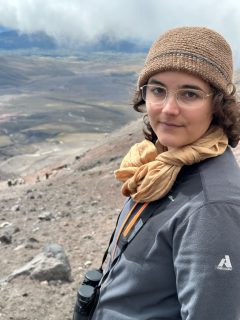
Emma Gometz is a journalist, illustrator, and performance artist based in New York City. When she’s not writing or thinking about writing, she’s probably waiting in a rush line for a Broadway show, doing yoga, or trying to learn about space by reading books meant for children. She’s currently a digital producer for WNYC’s Science Friday, but you can also find her words in Teen Vogue, The Open Notebook (where she’s an early-career fellow supported by the Burroughs Wellcome Fund), and The Columbia Spectator. Find her on X at @monkey_cabinet.