

What I’m working on:
I’ve spent the last year building a freelance business reporting on both physical sciences and environmental conservation for print and podcasts. One of my favorite and longest-running gigs is voicing and writing radio episodes for BirdNote. Chemistry and materials sciences are still my primary beat, but I’ve started developing a series of stories about habitat restoration and conservation ecology with a focus on biodiversity in Arkansas and the Southeastern U.S. I’m also expanding the podcasting side of my business and plan to publish a couple new projects in the fall. Lastly, I’ve got the seeds of a creative writing project scattered across note pads and paper scraps around my house that I’m hoping will germinate with help from the acknowledgment I’ve manifested in writing this sentence.
In the rest of my life, I’m working on my deadlift, making a set of ceramic noodle bowls on the wheel, becoming more proficient in Spanish, and learning how to band birds for a local observation station. With the flexibility that comes from freelancing, I’ve made time to volunteer as a curriculum coordinator for the Arkansas Master Naturalists and an eBird reviewer for central Arkansas. I love spending time in nature and often get story ideas while I’m enjoying the outdoors.
Where I work:
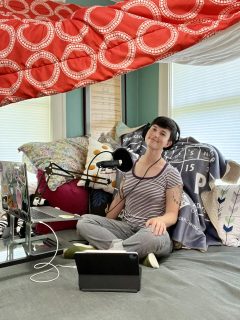
I am based in my hometown of Little Rock, Arkansas, where I live with my three cats: Nora, Lucy, and Chicot. I primarily work from a home office / guest bedroom. Between my standing desk, daybed, and floor, I can work in whatever orientation happens to be most amenable to making words that day. The daybed also doubles as my podcast recording studio—hence the mountain of throw pillows. A couple days a week, I go to a coworking space where I’ve found a welcoming community of independent creators and small-business owners.
Daily routine:

My schedule as a freelancer is flexible and changeable, but most days start out with several alarms and reminders of increasing urgency. One of those alarms turns on my local NPR station (shout out to Little Rock Public Radio) so that I wake up to the latest headlines. I’ll typically do a quick scan of my inbox and Slack while still in bed to make sure I’ve not missed anything time sensitive in the night. Then I brew a cup of coffee, dress as though I were going into a traditional office (shoes and all!) and arrive at my desk in earnest between 9:30 and 10:00 a.m.
The first thing I do is plan my day in a bullet journal, which includes writing my to-do lists, designating the top-three-priority tasks, and jotting down a short gratitude list. After I’ve addressed messages from editors and sources, I start clearing my inbox by reading through press releases and newsletters. I also like to unsubscribe from a couple junk email lists as a treat. My daily schedule varies widely after that.
I’m usually getting up to speed on Monday and decision-fatigued by Friday, so I like to schedule administrative tasks for those days and leave Tuesday–Thursday open for interviews, writing, and research. I listen to podcasts and take a walk around my neighborhood during my lunch break. I often take a second break sometime between 3:00 and 6:00 p.m. for “hobby time” (e.g., weightlifting, pottery, yoga, birding, etc.). If I’m not on deadline, I’ll wrap up my tasks list around 7:00 p.m. If I’ve got a big writing assignment, I’ll take a longer evening break so that I can work on copy late into the night.
Before I sign off every evening, I make a note about my perception of my productivity, energy, and general impression of the day. I look back on this section of my bullet journal each Sunday when I’m setting goals for the coming week, and then again during my quarterly review/reflection/self-evaluation.
Most productive part of my day:
I have the most energy and executive function between 11:00 a.m. and 3:00 p.m. When I’m working on a big writing project, I generally get the most words on the page between 8:00 p.m. and midnight.
Most essential ritual or habit:
When I really need to focus (especially at night), I invoke “tomato time.” I make myself a hot cup of tea, turn on a lo-fi or instrumental playlist (Lofi Girl and the Bridgerton Official Playlist on Spotify are recent favorites), and log into mytomatoes.com. It’s a very simple web interface based on a time-management method called the pomodoro technique, in which you work on a task for 25 minutes followed by a 5-minute break. The site also lets me make a note about what I accomplished in each “tomato.” I’ve used the platform since college, so I guess I’ve also trained my brain over the last decade to understand that tea, tunes, and tomatoes means go time!
Favorite note-taking techniques/tools:
For every new reporting project, I create a Scrivener file, which I use to consolidate all my background research, annotated papers, interview transcripts (transcribed via Otter.ai), correspondences with editors, and progress notes. I prefer to file copy in a Word document, but all of my initial outlines and drafts are written in Scrivener.
How I keep track of my to-do list:
I keep track of my daily to-do list using a bullet journal that I keep in a Moleskine Subject Cahier notebook. I use Trello to organize specific tasks lists for all my reporting projects, which helps me visualize where each item/client stands in my production workflow. I live and die by Google Calendar and always schedule interviews via shared events. Google Calendar also lets me create “tasks” that I schedule to ensure I’m hitting both my hard deadlines and soft progress goals.
I also keep a “kitchen sink list” for all the stuff that needs to get done eventually but has languished too long on the backburner. This catch-all system relieves the mental and visual clutter of an impossibly long daily to-do list without losing all accountability. I try to revisit this list at least once a quarter.
Essential software/apps/productivity tools:
There are five browser extensions I use almost every day: LastPass (an encrypted password keeper), OneTab (for consolidating open browser tabs), PrintFriendly (to turn any webpage into a printable pdf), Pocket (to hold onto stories I’ve read and would like to revisit later based on keywords), and Word Counter Plus (to check word/character length of online news stories).
Another website that keeps me going is screamintothevoid.com. I sometimes find myself hitting a wall due to my own self-sabotaging, but a couple entries into that website is typically all it takes to get me out of a rut.
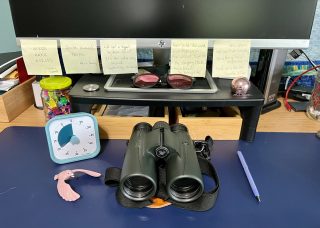
For editing, I love working through stories on paper with my handy-dandy clipboard and multitude of colorful pens (except red—never red!).
Favorite time waster/procrastination habit:
It used to be Twitter before I deleted my account, so now I’m glued to Instagram. I simply cannot stop myself from curating personalized collections of niche memes for friends (generally accompanied by the text, “and yes I AM on deadline!”) and getting little glimpses of what’s happening on the rest of the internet via screenshots and reposts.
My reading habits:
Besides the newsletters that I read as they arrive in my inbox, I use Google Chrome’s Reading List feature to save stories I want to peruse when I’ve got downtime (often on Friday afternoons in a scheduled reading period). My best estimate is that I’m currently reading nine books at varying levels of commitment and intensity (either in print, on an e-reader, or through headphones). The stack currently includes poetry, graphic memoirs, essay collections, nature and science writing, a romance novel, and an ornithology textbook.
It’s a deeply chaotic approach, but I read far more frequently now than when I insisted on sticking to just one book at a time. Plus the more I read, the more motivated I am to write.
Sleep schedule:
I am most functional after about 9.5 hours of sleep, so I try to be in bed between 10:00 and 11:30 p.m. and wake up between 8:00 and 9:00 a.m. I have to take an afternoon nap if I get any less than 7 hours of sleep (which the cats love to join).