

The way freelance essayist Erica Berry sees it, her book has been three books. The first was her undergraduate thesis, a journalistic reporting project about the controversies surrounding wolf repopulation in Oregon, her home state. Then, while getting her MFA in creative nonfiction, she wrote about symbolic wolves after some disquieting and distinctly gendered experiences of fear and anxiety. Being harassed by a stranger on a train and looking under her bed each night for an intruder made Berry curious about the representative meaning we ascribe to animals in fables such as “Little Red Riding Hood” and “The Boy Who Cried Wolf.” In this second iteration, she reframed herself—a young white woman, the granddaughter of a sheep farmer—as not just an observer, but part of the story.
Wolfish: Wolf, Self, and the Stories We Tell About Fear is the book that resulted from both explorations, a braided narrative of natural history, cultural criticism, and memoir. In the book, Berry’s coming-of-age while researching wolves runs parallel to the story of OR-7, a GPS-collared wolf who struck out on his own to journey through Oregon and California before eventually forming the Rogue pack. Berry’s omnivorous appetite for ideas is apparent throughout, as she draws on linguistics, folklore, sociology, wildlife biology, newspaper clippings, dozens of interviews, and stories from her own life. Every chapter interrogates a binary, such as “Town v. Wolf,” “Truth v. Wolf,” and “Mother v. Wolf.” And in each, readers learn at least one thing about wolf biology, one thing about the history of wolf stories, and one thing about Berry.
In a conversation with Kate Fishman, Berry spoke about using memoir to avoid the pitfalls of anthropomorphizing other creatures, her open-ended approach to interviewing, and how she found her own angle on an animal that gets a lot of attention. (This interview has been edited for length, flow, and clarity.)
Many people have written about wolves. How did you navigate around that to create something that feels different?
I thought often that my problems as a journalist were that I didn’t have a degree in biology, I hadn’t spent months with wolves in the Arctic, I didn’t have this amazing first-person testimony [from an experience] beside a wolf. It was helpful for me to [ask], “What do I have?” I’m writing about trying to see a creature that I cannot easily interact with. I’m going into the world where I’m encountering wolves digitally, on the side of RVs on the highway, on T-shirts, and I’m trying to say, “What is the wolf?”
I also wanted to write a book that was rigorous in thinking about wolves’ role in the ecosystem, while being able to grab readers who didn’t think they cared about wolves. How could you open different doors for people?
In the book, you’ve described approaching this story with “no real lens.” How did that shape your reporting?
I’ve come to think about research [using] the idea of a metal detector. You’re either looking for something lost, you’re trying to track down a fact, or you’re just looking for anything shiny and interesting. I think this book very much comes from that [last] idea. What if everything is potential source material on this?
There’s something so helpful about wearing that hat of [a] beginner’s brain. What if I go to 10 different disciplines and I ask, “How does the wolf appear in this discipline?” Because there’s a wolf tone in music, wolves are in linguistics, psychology, even in different disciplines of science. I didn’t want to sacrifice depth for breadth, but I also wanted to show the ways that this creature did exist in different categories and be able to humble myself by not presuming to be an authority in any one of those—even though along the way, like this rolling stone, I collected an amount of mossy, wolfy knowledge.
How did fear crystallize as the central theme in Wolfish?
I have some relatives who are less enthused about wolves. I was trying to think, why do they feel [that] way? When we think about how somebody makes their mind up, it’s a story [they’ve] heard, it’s a thing [they’ve] experienced, it’s something [they] saw on the news. I would go into a newspaper archive and search the word “wolves,” and it was fascinating how few of those articles were about real, flesh-and-blood wolves. There were lone-wolf shooters, wolves in sports, sheep in wolves’ clothing. At first it felt like these things [were] not important because I [was] just trying to talk about the facts. Then, I was realizing [the value of] showing those feedback loops between where the science story is and then where these emotional stories are.
I came across this French phrase that became a keystone phrase for the book—entre chien et loup, [describing] this hour where you can’t tell if the figure before you is a wolf or a dog. I realized so many wolf stories and proverbs were about that question.
Very often, fear is a form of fantasy about the unknown. I was interested in how those fantasies were created and what created them, because I was sick of living in a world where they loomed too large—and I didn’t feel it was fair for wolves to [be] made to be a vessel of people’s feelings.
How did you go about braiding the science story with those emotional stories?
I thought of the different chapters in Wolfish as thematic buckets, with each chapter breaking down a perceived binary, against the idea in a lot of popular imagination that the wolf is the foe of the human. I would read many different categories of books, take notes on them, write up my underlines, and then piece together which quotes from the different sections felt like they were speaking together. That first step of every chapter was a large constellation of other people’s words.
What discoveries came from writing about wolves while also writing about yourself?
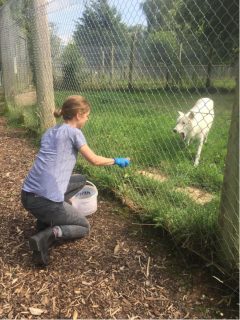
I went into writing about wolves being afraid of anthropomorphizing or projecting too much on them. Observing wolves in captivity [at the UK Wolf Conservation Trust in England], I would sit there and say, “OK, how do I describe the tail of a wolf? Does the tail look like a slinky?” Every metaphor felt wrong. Part of what I realized was that I, as a writer writing in my human language, was always going to be putting humanness onto this wolf.
Once I accepted that, I would hear about the way that wolf pups will go and investigate a scary thing, and I would think, “OK, that’s a cool wolf fact. I want to share that. Also, I am a person that is trying to think about how my fears can be about opening doors, or learning, or curiosity—not just closing doors.” Letting myself put my feelings on the page next to the facts about the wolf felt really hard, and I did come up against very gendered stereotypes around navel-gazing. But again, I felt like part of what I’m trying to write is what it feels like to be one animal watching another animal.
You write in the book about how wildlife biologists don’t like to focus too much on individual animals’ experiences, as opposed to impacts on a species as a whole. Why did you decide to trace the paths of individual wolves—and OR-7 in particular—through the western U.S. in Wolfish?
I sold this book on proposal, and OR-7 was not a wolf throughline at that point. In conversations with editors, it became clear that I needed more of a backbone. OR-7 had just died around that time, and I realized I’d started this book around the time that he had started [making headlines for wandering far from his pack]. His life cycle and my research cycle mirrored each other. I started looking for either physical resonances—at this point we both left Oregon, at this point we both crossed into a place where we were looking for somebody—or metaphorical resonances between our lives.
Part of what gave me permission to do that was [asking] biologists, “What did OR-7 mean to you?” Talking to a state biologist in Oregon who worked a lot tracking OR-7, he was like, “You know, [his death] did make me emotional.” There were documentaries and children’s books about OR-7. I’d already seen how this wolf resonated with people, so not only did I have data about the wolf’s journey, I had data about how people were reacting to that journey—which just made him a good source, in the way that an animal can ever be a source.
You wrote in a craft essay for Electric Literature: “We each wear more hats of knowledge than are immediately visible.” How did you tease out those different types of knowledge in your interviewing?
At first I thought, if I’m talking to a rancher, I can only talk to them about the threat of wolves predating on their livestock. Talking to my sister, who has an MFA in social practice and environmental art and has always done [oral history, performance art–style] interviews with the public, gave me permission to start breaking those interviews out of the boxes that I would have thought of. What if you also asked this person, “What does fear look like for you as a woman rancher?” We’re not even talking about wolves. I’m trying to parse, when you say you’re afraid of the wolf, what is that triggering in a larger psychology?
How did you steer conversations to those bigger conceptual questions?
My fear was that it’s going to make me [seem] less professional if I start getting into mushy, gushy emotional territory. Of course, I had to check that reflex. People get death threats for talking about wolves. Your professional life is always going to leach into your personal life, and so I wanted to ask questions that got at not just what they learned on a job—modeling, through my question asking, that sort of omnivorous curiosity.
I would be vulnerable in those interviews and conversations in ways that I didn’t used to do when I was thinking of myself purely as a traditional journalist. There were sources I talked to over the course of 10 years, in and out of each other’s lives. We’re both updating [each other] on how our thinking is evolving. What I learned from doing this is: Try to begin your first conversations with your sources as potentially the beginning of a long relationship.
 You write in Wolfish about contending with social and environmental inequities in your work as a journalist. How did that inform your reporting process?
In one of the first conversations I had with my amazing editor, Nadxieli Nieto, she said, “A lot of the sources you’re talking to who are experts about wolves are white people or white men. And they’re not the only experts on this. So how can we bring other voices into this book?” But it’s not like I search for the token wolf biologist of color—that’s not the point. The point is, for example, how are Indigenous perspectives on wolves informing these stories? The way I think about wolves is [also] informed by Isabel Wilkerson’s [book] Caste, because that is very much about historical constructions of “the other” that exist in America. Similar constructions are also projected onto wolves. I look to her as an expert in the same way that I’m going to go to a wolf biologist or conservationist.
You donated a portion of Wolfish proceeds to the Columbia River Institute for Indigenous Development Foundation (CRÍID) and wrote that “part of the project of this book is to begin to understand the ways my own body participates in the exclusion and alienation of others, both human and animal.” Why was it important to you to support this particular Indigenous organization?
So much of thinking about wolves and ecosystem dynamics is thinking about what creatures belong in a landscape. How did they come to belong there? How did they come to seem to belong there? I’d moved back to Oregon. I’d met the executive director [of CRÍID], this organization that’s doing [Ichishkín] language preservation and storytelling, working with young people. I felt like that [work] is answering many of the questions that this project is raising: How can we be supporting too-long-marginalized kinds of stories and kinds of authority? How can we break out of dominant narratives? Those questions of how to live responsibly as a colonial presence were front and center for me.
I loved your description in the book of “hunting stories” over the decade that you wrote it. How did you know when to stop, or are you still hunting stories?
Once I knew that my timeline of self was going to appear in this book, [the question was]: “What have I learned since I started this research, and since OR-7 died?” For a project that could otherwise just sort of be endlessly sprawling, having some form of thematic container [of my life in parallel with OR-7’s] was really critical.
I still get Google Alerts based on wolves and various keywords. Part of what’s so interesting is the comparative politics in different countries. Right now, we see wolves repopulating much of the world in places they haven’t been. We also see the rise of far-right governments or anti-immigrant sentiments in much of the world. It’s fascinating to follow how those things sometimes intersect. I feel like I will always be looking at the world through a wolf-colored lens.

Kate Fishman is a freelance journalist based in San Diego, California, and an early-career reporting fellow with The Open Notebook. She has covered local news in Ohio, Pennsylvania, and California’s Mendocino County, where she was a Report for America corps member and cultivated a love for writing about ecology. Her reporting has appeared in Sierra, Reuters, High Country News, and Atmos, among other publications. Find her on X @katefishreports and on Bluesky @kaatefishman.bsky.social.