
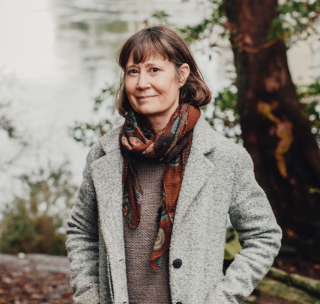
In fall 2024, Sarah Cox was digging through yet another long, dry report about the construction of Site C, an enormous hydroelectric dam on the Peace River in British Columbia, when a surprising detail caught her eye: The site’s developer, BC Hydro, planned to give its multibillion-dollar dam an Indigenous name. Cox was quickly on the phone with West Moberly First Nations Chief Roland Willson. She then wrote in The Narwhal, where she works as the publication’s BC bureau lead, about Willson’s outrage and disgust at the proposed name: “I find it completely offensive,” he told Cox.
The issue? To construct the dam’s reservoir, BC Hydro flooded 9,330 hectares that were culturally and spiritually important hunting, fishing, and trapping land for the West Moberly and other First Nations. An Indigenous name seemed less of an honor and more of a slap in the face.
Cox was able to get Willson on the phone so quickly in part because she has become a familiar figure among the residents, politicians, activists, and corporate officials who have been clashing over Site C for years. She first visited the Peace River Valley in 2013, and her 12 years of writing about the dam has become the definitive account of Site C’s construction and impact.
Throughout its development, the project has been met with pushback from residents of the Peace River Valley, an ecologically unique area that sits at the confluence of boreal forest, eastern plains, montane foothill, and alpine ecosystems. It is home to the Dunne-Za, Saulteau, and Cree people, among others, for whom the Peace River is central to their way of life. Settlers, too, farm the land there, as it holds some of the best arable soil in northern BC. Nonetheless, the provincial government decided to allow BC Hydro to clear cut and flood the valley to construct Site C—even as its cost ballooned from $6.6 billion to $16 billion (CAD), and even as cheaper forms of renewable energy became available.
In the process of her reporting, Cox has met with dozens of residents (settlers and First Nations alike), combed through tens of thousands of pages of reports and court documents, and interviewed experts in fields as varied as agriculture, hydroelectricity, and paleontology. She synthesized much of this work into her 2018 book, Breaching the Peace.
Each chapter details a facet of the dam’s impact, from its biological devastation to the effects on First Nations’ livelihoods to the psychological toll on residents, while homing in on its inefficiencies in generating clean energy and the political machinations that made it happen. The book was a finalist for the 2019 Shaughnessy Cohen Prize for Political Writing from the Writers’ Trust of Canada.
Cox has continued to cover the dam’s progress for The Narwhal, first as a freelancer, then as a staff reporter, and now as an editor. She won the 2021 World Press Freedom Award for her coverage—and she’s not done yet.
Cox spoke with William von Herff about her work on Site C, including how she has navigated reporting on the project for so many years, how she established trust with sources that both oppose and support the dam, and how she maintains hope even as the project’s negative effects start to emerge. (This interview has been edited for length and clarity.)
How did you first identify Site C as a subject worthy of coverage?
I had been up to the Peace region of BC, and I started to hear stories from people who would be directly affected by the project—people like third-generation Peace Valley farmers Ken and Arlene Boon, chief Roland Willson from West Moberly First Nations, and many, many other people who had farms or ranching operations along the Peace River [and] First Nations who use the area for cultural practices. I just was really looking into the question of, do we need this project, and why is it being built, and who is it going to affect?
The other context is that the same amount of power could be generated for far less cost, with far less of an environmental impact. With an investment of $600 million [that BC recently put towards nine new wind projects, the province will] produce about the same amount of power that Site C will produce for $16 billion and counting.
So often we talk about clean energy and hydro power as if there are no impacts, when really there are tremendous impacts—especially with big hydro projects like Site C—and they’re kind of swept under the carpet under the pretext that we are providing clean energy. It just seemed that the government moved ahead with this project for political reasons, not for power reasons. There’s always a tradeoff, and we’re not doing ourselves or the affected people and communities any service by not talking about the impacts.
How did you find sources in the area?
There was a joint provincial-federal review panel that did an environmental assessment, which also looked at the social impacts and people. There was a lot of testimony from folks in the north [of BC, where the Peace River is], from different First Nations, from environmental groups, from farming and ranching and other communities, and agrologists—just a whole host of testimony.
So I went back over the testimony and looked up some of these names and contacted them. One person kind of led me to another. People were very open to talking about the impact that it would have on them.
There was also kind of a pivotal moment in what was becoming a concerted effort to try to stop the project, where farmers and First Nations set up a winter camp after preliminary clearing work for the project began, and I actually went and spent a few days at the camp. So I spent time with people that way as well.

How did you educate yourself on the myriad facets of Site C’s impact?
I spent a lot of time digging through reports. That environmental assessment, although short in time, produced a lot of documents. They were geotechnical reports and reports on the environmental impact. All of that was fairly well documented, just not easily accessible—it was a lot of combing through reports. And then from there, it led to filing freedom-of-information [FOI] requests and getting more details.
It was [also] a lot of talking to hydro experts. The former CEO of BC Hydro turned out to be an outspoken critic of the project. The person who led the joint federal-provincial review panel to the project, a man by the name of Harry Swain, also became an outspoken critic of the project. And he was also a resource.
The other source of information were the court cases. So there were numerous court cases to try to stop the project: court cases from landowners like Ken and Arlene, multiple court cases from First Nations, and the BC government launched a civil action against some of the people who were camping at that winter camp. I went through all those [publicly available] court documents as well. On top of the personal stories from people and talking to experts, it was a lot of piecing together the story from various documents.
How do you keep track of this vast swath of information that you’ve gathered over the years?
I can’t profess to have the most organized system in the world. I have some binders of information, including FOIs that I printed out. A lot of stuff, if I can still find it on the internet, I won’t keep it, but I will do screenshots if I think something might disappear and chuck it into a file. I have about two boxes of notebooks and tapes that I have kept, a bunch of resource books, including about the history of power and hydro generation in BC, any report that was done on Site C. They’re stored right now, but I can’t quite let those boxes go.
You published articles about Site C at the same time you were working on your book. How did you choose which pieces of reporting became articles and which ones ended up in the book?
There wasn’t a really good science to it. It’s reporter’s instincts—when you’re listening to something and you go, “Oh, that is a really good story.”
I was [also] just trying to balance them out, like get some stories out there that I felt were important to get out and not wait a couple years until a book was published, and then just not having time to write stories while I was frantically trying to finish a chapter or something like that. It just was what I was able to do at the time.
Do you remember any specific instance where you saw something and thought, that has to be its own story?
Yes, I do, actually. There was this plan to, quote, “mitigate” some of the effects of the dam on migratory trout. BC Hydro had proposed to spend millions and millions of dollars on a scheme to build this contraption for the trout to get them over the dam that involved moving them up through a series of pools, anesthetizing them, and ultimately trucking them past the dam in vehicles for an untold number of years at great expense.
I looked around to see if there were any other instances where these so-called fish ladders had been used for trout. [I] talked to scientists in the States who had tried it, and it had failed miserably. But that didn’t seem to matter in this instance. And so that I didn’t wait to put in the book. I did a story about that. [The fish ladder was built anyway,] but last I heard not many bull trout had managed to get upstream to their spawning grounds.

How did you establish trust with sources on all sides of the situation, including those opposing the project and those constructing it?
I tried to actually go to the region, which I managed to do a few times, just to meet with people in person. I think people were very eager to tell their stories because their stories were not being heard—most people in British Columbia didn’t know about the project.
They [the locals] were very generous in terms of inviting me into their world, and I always tried to be respectful of the fact that I was there reporting on them, and [asking] whether it was OK to include something they told me in the book or not. Many people told me they just had never had experience with the media or being recorded or doing interviews before, so I just tried to be really open about what I was reporting, to run things by people, and to make sure they were OK with how I was reporting it.
[I didn’t have any issues] with anybody on the ground that I’m aware of, but I did have some very difficult moments with BC Hydro in the early days. They actually issued a press release—twice—about my reporting saying it was inaccurate when, in fact, I’d taken the information from their own reports. I think they did it in the early days even with a reporter from The New York Times, just trying to discredit any reporting that questioned anything about the project.
Over a couple of years, that shifted. As soon as it was public that this was happening, things started to change. Now, I feel like my emails are answered.
What is it like living in the headspace of a story like this for years and years?
I kind of go through different phases. I definitely had a phase where I could talk about little else. Friends would invite me over for dinner and say, “Oh, you can give us a Site C update!” and I was like, “Yep, don’t push my Site C button, or I might talk for the whole evening.” And then I go through a phase where I’m not paying that much attention to it.
But certainly, just because I [have] spent so much time working on this issue and writing about it, it’s very near and dear to me, as are the people up in the Peace who are living with this on a daily basis.
The stories of Site C are often depressing. How do you maintain hope in the face of it all, particularly as so many of the anticipated harms come to fruition?
My antidote is just to spend time in the natural world. I’m a big hiker and kayaker, and I go spend a day in the wilderness, and that certainly helps me deal with everything.
I think at some point I just came to see my role in [this project] as bearing witness and documenting things, and so that kind of gave me hope that I was able to do this. I feel like my job [is] to look at things in a more complicated way. We need power for the clean energy transition. How are we going to do that? What are the tradeoffs? Let’s be really honest about what the tradeoffs are here, both in terms of the impact on people in communities and the impact on the environment. I find hope in asking those questions and then in telling those stories.

William von Herff is a freelance science journalist and former staff writer at The Provincetown Independent. His work has appeared in The Atlantic, WIRED, Smithsonian, Atlas Obscura, MIT Technology Review, and other publications. William is a TON early-career fellow sponsored by the Burroughs Wellcome Fund. Follow him on Bluesky at @willvh.bsky.social.