

One July afternoon in 2024, a team of scientists oohed and aahed as cold-water corals—spiky, gelatinous, slow-moving creatures—plopped eggs and sperm into the water of a glass tank. In a borrowed fishery-turned-lab, the researchers—part of an international scientific collaboration—had kept watch daily from dawn to dusk to try to catch this moment. They were on a mission to bring about one of the first-ever reproductions of Desmophyllum dianthus in a lab, hopefully a step toward restoring coral reefs in the wild. Freelance science journalists Christian Elliott and Muriel Alarcón had traveled to Patagonia to report on the milestone.
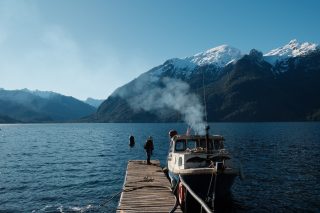
But at the moment of the spawning, Elliott and Alarcón were on a ferry sailing back from Comau Fjord, the habitat in Chilean Patagonia where those same corals had been born, about 90 kilometers away from the lab. With no direct overland route, the journey took 16 hours. When they finally disembarked, they learned that the very event they had come to witness had taken place while they were gone.
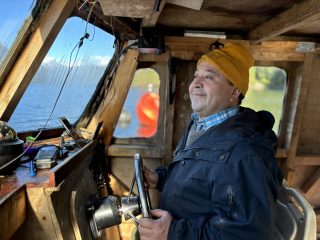
Like their warm-water counterparts, cold-water corals face threats from pollution and destructive fishing practices, but their deep-sea habitat makes them harder to access and study. Comau Fjord is one of the few places where these cold-water corals grow close enough to the surface for scientists to examine them up close. To reach the remote site, Elliott and Alarcón had to take three ferries and a boat operated by Boris Hernández, a local fisherman and guide and one of the few people who knows exactly where the corals are.
Elliott and Alarcón knew that leaving the lab to visit the fjord risked missing the exact moment they had hoped to witness. But looking back, neither one regrets their choice. In their resulting stories, both journalists featured scenes set in the fjord and with Hernández. Elliott’s November 2024 article in Hakai, “The Secret Sex Lives of Deep, Dark Corals,” opens with the scene, a pivot he described in his newsletter on the craft of science journalism. The story, among the last published by Hakai before its closure, is a narrative feature in which he exposes how understanding deep-sea coral reproduction could lead to their preservation. Alarcón’s August 2024 story for the Spanish newspaper El País, “La vida secreta de los corales de aguas frías de la Patagonia,” focuses on local tensions, the threat that salmon farming represents for these species, and how the discovery of the corals led to the creation of a protected area. It also highlights how the wisdom of inhabitants like Hernández serves as an additional protective barrier for the fjord and its corals.
Here, Elliott and Alarcón talk with Lucila Pinto about how they determined their respective angles within their collaboration, what each learned from the other’s interviewing style, how local knowledge enriches science stories, and what to do when plans deviate from their original course. (This interview has been edited for length and clarity and parts have been translated from Spanish.)

How did you start working together on this story?
Alarcón: Christian and I met in Dubai [at the 28th United Nations Climate Change Conference (COP28)]. We were both fellows at the Pulitzer Center and were invited to speak about stories we had written. We realized we had common interests, and then I received this wonderful invitation [from him].
Elliott: The idea for the story also came from COP28. I went to a session about cold-water corals. I hadn’t heard about them. You read about tropical corals bleaching and being doomed. I had this question of [whether cold-water] corals in the deep sea, that are more widespread and [have] more species, are going to be the corals that survive a changing climate. When I got back home, I reached out to an organization called Coral Research & Development Accelerator Platform. They put me in touch with a team from Sweden. I corresponded with scientist Rhian Waller. She had work planned in Chile and invited me to come. It seemed like if I wanted to write about deep-sea corals and actually see them, this was [where] it could happen. I applied to the Pulitzer Center for a grant to travel there and called on Muriel to report it with me.
Alarcón: When Christian wrote me, [my first thought was], Is this possible in my country, in Patagonia? Our waters are probably [some] of the coldest in [the Americas]. I felt amazed that biodiversity depends on this coral, and about the fact that there was this group—both international and local scientists—[whose] story hadn’t been portrayed.
Elliott: I don’t speak Spanish. I’m not from Chile. I had to figure out if there was a reason for me to go. I landed on: It’s this international team of scientists, and I cover science. But it wouldn’t have been possible without this partnership to understand the local context. Muriel was a translator for me during some interviews. I applied for the grant on my own, but Muriel was part of the plan from almost the beginning. I paid her from the grant I received for field reporting support, translation work, and so on. She is also listed as a collaborator—with her byline—on the Pulitzer Center page for the project.
How did you determine the angles for each of your stories?
Elliott: I already had the assignment from Hakai. They liked doing stories about a scientist in the field trying to figure something out. So I knew that was the angle.
Alarcón: I knew I wanted to write about the scientists’ work and the ongoing conservation efforts. I also knew the impacts of salmon farming had to be part of the story—it’s a highly relevant issue in that region. That’s how I pitched it to my editor at América Futura [a section of El País that focuses on Latin America]. Before the trip, I told my editor that I was going to accompany Christian on his project and that I’d love to use the opportunity to report on a topic in line with the pieces I had already published with them, [such as one on endangered wetlands in Chilean Patagonia and another on pollution caused by the fast-fashion waste dumped in Chile’s Atacama Desert].
How did you work together during interviews to capture a breadth of information from sources?
Elliott: Muriel had great questions for Boris Hernández. You took the lead on some conversations with him. You had good ideas about what to ask in terms of what he’d seen change in the fjord in his lifetime.
Alarcón: Christian is a wonderful journalist, but he could be a wonderful scientist too. He goes into the subject with this great obsession. I am always looking for the human perspective in my stories. When we were interviewing Rhian, Christian started asking [specialized] questions about the corals’ lives and reproduction. Then I started to ask about her life, her career, and why she started to study something connected to the deep sea. I think the mix resulted in multilayered stories.
How did getting to know Boris Hernández and interacting with him influence your articles?
Alarcón: [We had] the idea to visit the fjord from the beginning, but when we were in the lab, we realized how difficult it was to arrive there. One scientist from the lab, Ignacia [Acevedo-Romo], advised us to reach out to Boris.
He seemed very interesting because this was [a] resident who had lived his entire life in the fjord. He used to be a local fisherman; today, he makes a living mostly from tourism. For years, he’s collaborated on scientific expeditions, contributing local knowledge to high-level research. He’s not just a witness, but a key player in the discoveries. He understands scientific language and has been part of the process of understanding and protecting the fjord. He told us that a lot of people reach out wanting to know where the corals are, but he asks for their motivations for visiting before agreeing to take them.
People like him show that knowledge isn’t exclusive to academia and that local insight can be essential to understanding global processes like climate change. From our first conversation, I knew he was a window into both the past and present of that place.
Elliott: If we hadn’t been able to see the fjord, where these corals come from, and [understand] why conservation is important and what the people who live there think about the corals, the story would not have been nearly as interesting. I knew from fairly early on that I wanted to start with [a] scene of [Waller] getting a text saying, “the babies are coming,” and [running] to the lab. But my editor [Krista Langlois, now at bioGraphic] made the very good call that we needed to set the stakes and set the scene first. We didn’t want to rush into a lab without knowing where the corals came from and why we should care about them.
How did you feel when you learned that you had missed the spawning?
Elliott: I was worried when I was writing because that was the one thing I had promised my editor: The reason I’m going is to see the spawning in person when it happens. And then we didn’t have it. But she was very reassuring about it from the beginning. She said it’s okay, there’s video and you have and all this other material.
What’s your advice for when it’s not possible to stick to your original reporting plan?
Elliott: [For] things that you don’t witness in person, you’re [still] able to do interviews with the people who were there and have them explain exactly how it went down, what they were seeing and feeling.
[The scientists] even recorded a spawning for us. I asked them to set up a phone and record audio of the spawning event as a voice memo. They were planning to record videos and take photos anyway. They have tricks like pressing [a] camera right up to the glass or putting them in the tanks to avoid glare. But they wouldn’t have recorded a voice memo otherwise, and I wanted to hear their reactions to the spawning to recreate the scene. I think it worked, and you still get the excitement in that part of the story, even though we missed it. So, I guess the lesson is: Be there as much as you can, be prepared, but if you miss something, it’s not the end of the world.
Alarcón: When things happen, there’s a wonderful story to tell. When things don’t happen, there is a wonderful story to tell, too. What was wonderful was to see how science works. For these scientists there was no certainty about when things were going to happen. To see that the scientists had to wait—to see them worry about things not working—gave me a lot of material as a reporter. It confirmed a lot of what I think about science: It’s inexact, uncertain, unexpected.

Lucila Pinto is a freelance science and tech journalist. Her work has appeared in Science, Rest of World, and La Nación, among other publications. She is a Pulitzer Center reporting fellow and a graduate of Columbia University’s science journalism program. She is currently an early-career fellow at The Open Notebook supported by the Burroughs Wellcome Fund. Follow her on X @luchipaint and on LinkedIn.