
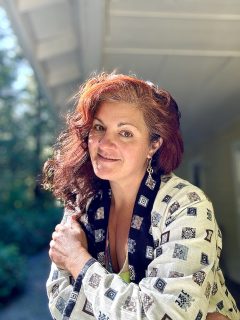
Starre Vartan has never been one to shy away from physical activity. As a child, she scrambled up trees, built forts in the woods, and raced through her chores so she could play with her friends. Her grandmother, who raised her, was no slouch either. She chopped wood and fixed stone walls at their house in New York’s Hudson Valley into her 80s. Vartan gained a sense of confidence in her own physical prowess as she found her body’s strengths and watched her grandmother work. But away from home, she heard a different message. When moving chairs at school or hauling sports equipment at summer camp, others suggested she ask for help from a boy or a man, even though she knew she didn’t need it. “I never understood why the female body was considered to be the weaker sex,” she recalls.
This question remained in the back of Vartan’s mind through college and into her journalism career. She kept up with research on female bodies and steadily collected information while covering research on animals and the environment. In 2019, she penned a feature for Elemental about the emerging research on female bodies’ unique advantages in athletic performance and gaps that still existed in the scientific literature. But she quickly realized she had more to say than could fit into a few thousand words.
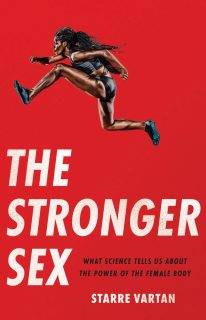
In The Stronger Sex: What Science Tells Us About the Power of the Female Body, Vartan digs deeper into how female bodies, on average, outperform male bodies in physical endurance, immunity, and longevity. She also highlights the pervasive lack of scientific research focused exclusively on female bodies, not just in sports science, but in medicine and physiology. Along the way, Vartan weaves in her own lived experiences—including handling the pain of being kicked in the face by a mule deep in the mountains—alongside accounts from an immunologist, a competitive woodchopper, and several others. Together, these interviews illustrate many facets of female strength and combat the misconceptions and harmful cultural narratives that have devalued the power of female bodies.
Vartan spoke with Skyler Ware about crafting an engaging and inclusive narrative, reporting on emerging research, and building her overview of this fast-developing field. (This interview has been edited for length and clarity.)
Who is this book for? How did you conceptualize your audience?
I got a little bit of an idea of that from the Elemental feature article. Elemental’s data was good because, as a contributor, you could see who read your pieces. In that case, I saw that it was like 80 percent female. But that meant it was [about] 20 percent male, which was interesting. And then I had a bunch of comments from people who were like, “Oh, my daughter is in athletics,” [or] “I’m a coach.” Those people are all really interested because they know from their own experience that there isn’t as much information as would be ideal. That was a part of the audience that I hadn’t anticipated. I figured out, this is going to be for people who are interested in female bodies.
In many ways, research on female bodies is still emerging. How did you handle reporting on uncertainty and gaps in the existing literature?
That was a huge challenge. I wanted to come out and say, “Here’s some stuff we really know [that] points in a specific direction, and here’s where we don’t know things.” There are some strong statements I think that I made fairly. A good example is the strength of female immune systems over those in male bodies. XX is stronger than XY when it comes to fundamental immune defense and offense. We see this through genetic studies and also the fact that baby girls and elderly women both out-survive infant boys and old men, [times] when hormones are less impactful. And there are other places [where] I don’t think it would have been fair to make strong statements. Hormones [for example, are] a tremendously large black hole. I didn’t even know until I got into reporting some of the immunology—because hormones have such an impact on the immune system—how little we knew about hormones.
The level that we are at [in] understanding even some of the basic biology of female bodies is [such] that sometimes you’re going to get information that’s going to make you ask new questions or doubt your own hypothesis. [In] some areas, it seemed to me that the question no longer was, “What’s the difference between male and female bodies?” There’s [an] example of this that comes from ski racing and ACL injuries. While in amateur athletes you see a sex disparity in ACL injuries, [where injuries occur more frequently in female athletes than in male athletes,] as you advance to more elite levels, where players are getting more equal training and coaching, you see a more even ratio of these injuries. There’s areas where we’re seeing [a] difference and exploring that difference is important, but other areas where exploring that difference has revealed that what makes somebody strong or weak has nothing to do with sex. It has to do with training. It has to do with muscle type. It has to do with many other factors, and sex is the least of them, which goes against the argument of parts of my book, perhaps. But that’s what a good scientist does. They look at the information and say, well, maybe I’m asking the wrong questions.
You spoke with several non-scientist experts, including a korfball player for a section on mixed-gender sports teams and elderly women in Okinawa, an area known for exceptional longevity, among others. How did you approach finding people to talk to?
[Finding non-scientist sources] was definitely one of my bigger challenges, because I don’t have as much experience doing that kind of reporting. For the korfball player, I actually went to the International Korfball Federation, headquartered in the Netherlands. I did the classic reporter thing, and I was like, “Who would be good to speak with? I’d love to go to a korfball game.” And they were really responsive and helpful.
Finding individuals [outside of organizations] was more difficult. I knew I wanted to go to Okinawa and speak with the older women there, but I knew that the language barrier was going to be an issue. I hadn’t done interviews in another language before. I found this woman, Christal [Burnette], through YouTube. She spoke Japanese, lived in Okinawa, [and] was part of the [Okinawa Research Center for Longevity Science] there. She’d just stumbled across this bar [where] there were 90-year-old women hanging out, and she spent the evening with them. She was like, “I’ll ask them if they’d be interested in talking to you.” She then set it up, so I paid her to be my translator and my fixer.
How did you decide when to stop reporting?
 I gave myself a strict schedule for reporting and writing each chapter. So I used the designated time I had [for each chapter], and then I had to keep going [to the next one]. If I [later] found something or thought that I really needed [another] voice, I would put a note at the top of my draft. Months later, when I was done with other chapters, if it still seemed important and relevant, then I would address it. But about half the time, I was like, “Oh, I kind of already said that,” or it seemed exciting at the time, but it wasn’t.
Of course, I went back when new information came up [or] new studies were published. Even in the copyedits phase, there were a few pieces that I dropped in. In fact, one of them came after fact-check, and then I made a mistake, which is so frustrating. I wrote [that] Tara Dower became the fastest person ever to complete the Appalachian Trail in September 2024, which happened while I was in final edits for the book. While that main fact is correct, I also included an incorrect detail. I wrote that her record was 4.5 days faster than the previous record-holder—a guy—when it was only 13 hours faster. The 4.5 days was another racer in another race. It’s 100 percent my fault, because the fact-checkers had already done their job. It’s hard with a book. You want to not have it feel out of date when it comes out because of the lag between finishing writing and publishing.
What steps did you take to make your writing gender-inclusive?
That was really, really hard. I did start [working with sensitivity readers] about three-quarters of the way through the process.
I have a good friend from college who’s a transgender guy, and I hired him to read just for that. Kaedyn [Nedopak] gave me a lot of good advice. Some of it I felt wouldn’t [work]. Using AFAB [assigned female at birth] and AMAB [assigned male at birth] throughout the book was not realistic—not just for readability issues, but also because most of the science that has been done uses “male and female bodies,” and prior to that, “men and women.” So, if I’m talking about someone’s study where they use “men and women,” I can’t use another word than the scientists use in their paper. It was a very imperfect process. I also had a transgender woman read it later, Katelyn [Burns]. Katelyn is an MSNBC reporter, and I didn’t know her personally.
They both helped me refine the language, and they also provided resources and information and context. [They] pointed me towards places where it made sense to include trans and intersex people in discussion of cultural aspects of sport and lack of research, or in places where research including non-binary people would add to our knowledge for all humans. For example, they pointed me toward the Trans Health Research program in Australia and how there’s now a nonbinary category in a half dozen marathons around the world—showing how there are ways to be inclusive.
These readers also pointed out details about their own transition experiences and questions they had, which informed some of my queries during interviews. Kaedyn was really interested in the immunology angle of his transition and how that might be impacted.
How did you think about crafting the book’s narrative so that would appeal to as many people as possible?
I have my own unique story, and it is popular now for science journalists to include some memoir, so I think that’s a way in. Even if somebody doesn’t share your story, it’s relatable because you’re being human.
[Other readers might] pick a couple chapters that interest [them]. There’s different ways in for different groups of people. That’s something I always talked about when I did environmental reporting: People care about environmental issues a bunch of different ways. [Maybe] it’s because they’re foodies, and then they care about where their food comes from, and then they understand soils and clean water. Or they’re surfers. My dad was a surfer, and he got really into ocean health because he was surfing and saw sewage.
That was part of why I made the book cover the variety of topics that it [does]. There’s plenty of people who are going to be interested in the muscles chapter. People who are less sports-oriented will hopefully like the chapter on the eggs and the uterus and reproductive organs, [or] the longevity [research].
Your voice and tone throughout the book are quite frank: You point out that tailoring a training plan to an athlete’s menstrual cycle could turn out to be “a big nothingburger” and refer to former U.S. women’s soccer star Megan Rapinoe as an “all-around badass.” What does that approach offer your readers?
I just got a Goodreads [review]. They gave me three stars [out of five], which is nice, but they were like, “I really disliked her Millennial tone.” That’s totally fine! But it did make me laugh because I was going for that energy to attract more people to reading science. The way to do it is to make things feel relatable and make me feel like a real person, and there’s parts of my personality that come through, which some people may not like. But that’s reality, right? You don’t like everyone you meet.
Honestly, if someone were to come to me with a study saying we’ve surveyed 10,000 readers, and we found that the majority of people really think that [a particular] kind of science writing gets more people to read about science, I would do that. Because that’s my primary motive. I am so passionate about science and getting these researchers’ ideas and information out there. My whole thing is to try and get more people in.
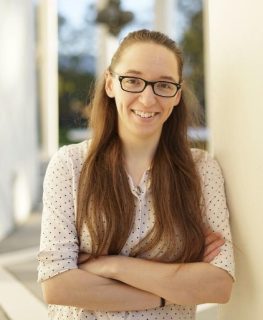
Skyler Ware is a freelance science writer covering physical and Earth sciences and a TON early-career fellow supported by the Burroughs Wellcome Fund. Her work has appeared in Eos, SciShow, Live Science, and others, and she was the 2023 AAAS Mass Media Fellow at Science News. Skyler has a PhD in chemistry from Caltech. Find her on Bluesky @skylerdware.bsky.social.