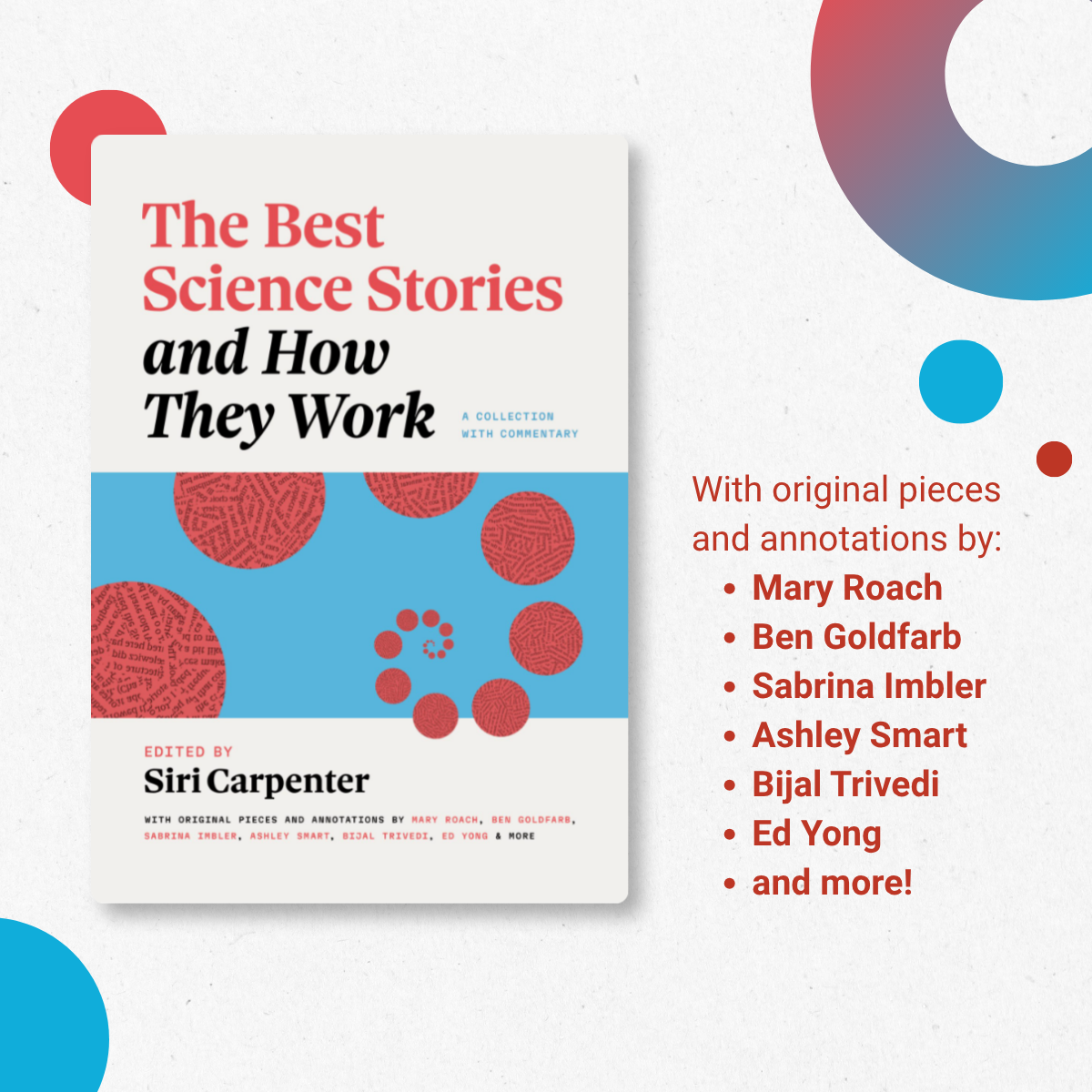
At the risk of being tactless, I must say that I love The Best Science Stories and How They Work: A Collection with Commentary, which will officially launch a week from today. It was an incredible joy to curate and edit this collection of annotations and writer interviews. How could it not be? After all, I started with stories that I’ve enjoyed and admired, written by journalists I look up to, and then asked other writers I deeply respect to roll up their sleeves and deconstruct those stories—to shine a light on the qualities that make them powerful. For an editor who likes to take things apart to figure out how they work, this was a recipe for nerdy enjoyment. I’ve always loved story-behind-the-story analyses; early in my career, I spent untold hours reverse-outlining stories as a way to teach myself about story structure.
The Best Science Stories and How They Work is the culmination of a process that began twelve years ago, when I first approached leaders of the Council for the Advancement of Science Writing (CASW) with the idea of creating a series of annotated stories that would highlight what makes the best science stories so good. That initial conversation eventually led to the popular Storygrams series, the first eighteen installments of which were co-published at The Open Notebook and at CASW’s Showcase website.
Selecting and editing those Storygrams was pure pleasure, and I was thrilled that these pieces were greeted so enthusiastically by journalists and writers of all kinds, from early-career writers who, like me, were hungry to better understand how to tell stories well; to journalism instructors at the graduate, undergraduate, and even high school level who embraced them as tools for teaching; to mid-career and established writers who wanted to take their skills to the next level.
So when Joe Calamia, my editor at the University of Chicago Press, suggested to me and my agent Gillian MacKenzie that we undertake a print version of the Storygrams concept, a volume of entirely new works that people could hold in their hands and scribble in the margins of, it was an immediate Yes, please! It felt like one of those full-circle moments, as I found myself remembering an undergraduate science writing course I’d taught more than a decade ago at the University of Wisconsin-Madison. In many ways, this book is the teaching tool that I wished for then. What I wanted was something that would help my students peer into great writing for the purpose of learning; that would tune their minds to the choices writers make and how those choices affect readers’ experience; and that would equip them to be able to make an impact with their own stories.
As I wrote in the book’s introduction:
[T]his collection offers more than just examples of outstanding storytelling. It’s an invitation to walk side by side with some of today’s most thoughtful and respected science journalists as they look beneath the surface to see how these stories were constructed—and talk with the authors to get an intimate look at the decisions and challenges that shaped their work. Think of this annotated collection and the accompanying author interviews as analogous to the director’s cut of a favorite film. They provide a window into the craft of science writing, enriching your enjoyment by making the choices behind exceptional storytelling visible and accessible. You’ll immerse yourself in learning how the best science stories are reported and written, perceiving the choices, challenges, and decisions that are fundamental to good science journalism.
And in fact, every story is a science story. Nearly every issue society wrestles with—climate change, public health, artificial intelligence, local infrastructure, education policy—has science at its heart. And so the craft skills showcased in the best science journalism are essential for reporting effectively across all beats, not just traditional science coverage. Every journalist needs to know how to evaluate evidence, understand complex systems, discern causality, and communicate technical information.
I hope this book will find its way into your hands, and that you’ll soon be scribbling your own notes in the margins, adding to—maybe even arguing with—the annotations already there. When that happens, you’ll be in conversation with some of the best journalists working today. Because as much as I adore the annotations and interviews in this volume, what I love most about this book is that, like everything we do at The Open Notebook, it’s grounded in community. It’s not me telling you what makes the best journalism great; it’s a collective effort to understand, to exchange ideas, to celebrate, and to help one another be better. And it’s rooted in the idea that’s animated TON from our beginnings more than 15 years ago: for all the tremendous challenges journalism faces as an industry, high-quality craft still matters. In fact, it matters more than ever.
A Sneak Peek at The Best Science Stories and How They Work
Excerpts reprinted with permission from The Best Science Stories and How They Work: A Collection with Commentary edited by Siri Carpenter, published by the University of Chicago Press. © 2026 by The Open Notebook, Inc. All rights reserved.
Publication of The Best Science Stories and How They Work was supported by a grant from the Alfred P. Sloan Foundation.