
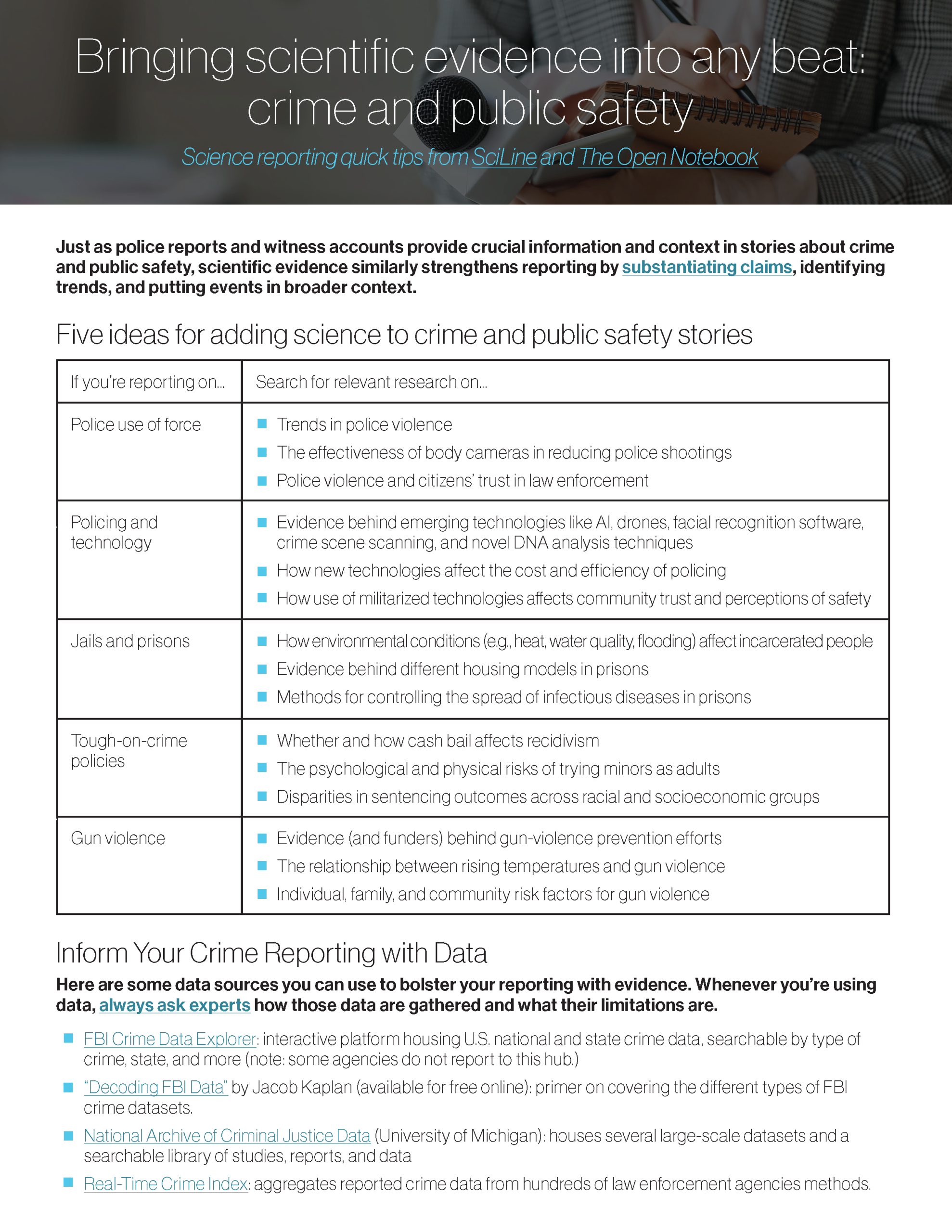
Just as police reports and witness accounts provide crucial information and context in stories about crime and public safety, scientific evidence similarly strengthens reporting by substantiating claims, identifying trends, and putting events in broader context.
Five Ideas for Adding Science to Crime and Public-Safety Stories
| If you’re reporting on … | Search for relevant research on … |
| Police use of force |
|
| Policing and technology |
|
| Jails and prisons |
|
| Tough-on-crime policies |
|
| Gun violence |
|
Inform Your Crime Reporting with Data
Here are some data sources you can use to bolster your reporting with evidence. Whenever you’re using data, always ask experts how those data are gathered and what their limitations are.
- FBI Crime Data Explorer: Interactive platform housing U.S. national and state crime data, searchable by type of crime, state, and more (Note: some agencies do not report to this hub)
- Decoding FBI Data by Jacob Kaplan (available for free online): Primer on covering the different types of FBI crime datasets
- National Archive of Criminal Justice Data (University of Michigan): Houses several large-scale datasets and a searchable library of studies, reports, and data
- Real-Time Crime Index: Aggregates reported crime data from hundreds of law enforcement agencies
- SPOTLITE (University of Illinois): Tracks incidents where police use firearms
- Center for Gun Violence Solutions (Johns Hopkins University): Publishes an annual report of gun violence in the U.S.
- Investigate This! (The Marshall Project): Gathers datasets and reporting resources for local journalists covering criminal justice
- Gun Violence Data Hub (The Trace): Comprehensive source for gun violence data in the U.S.
- CrimeSolutions (DOJ): Summarizes and evaluates research on criminal justice interventions in the U.S.
- National Crime Victimization Survey: Annual survey of U.S. households on self-reported experiences of both reported and non-reported crime
This tip sheet for reporters is part of the Science Reporting Quick Tips series, a partnership between The Open Notebook and SciLine.
More in This Series
Common Pitfalls to Avoid
- Avoid extrapolating data – Carefully assess what the data you’re citing are measuring, how the data were collected, who funds the dataset, and whether there’s a certain narrative being pushed.
- Explore underreported crime – Look for local surveys in your county or city to assess rates of perceived safety and crimes that aren’t reported to the police.
- Don’t overlook nonfatal gun violence – Reporting on gun violence tends to focus on mass shootings or homicides when nonfatal gun violence is far more common.
Types of Experts to Contact and Questions to Ask
Ask psychologists about:
| Ask epidemiologists about:
|
Ask sociologists (e.g., criminologists) about:
| Ask engineers and computer scientists (e.g., biometricians) about:
|
Real Stories Including Scientific Evidence and Experts
- Facial recognition in policing is getting state-by-state guardrails (Ohio Capital Journal, 2025)
- 6 myths about California crime as voters now favor this measure on drugs, retail theft (Cal Matters, 2024)
- A public health response helped reduce fatal car wrecks in Texas. Can it do the same for gun deaths? (Texas Tribune, 2023)
Further reading: Covering federal involvement in local policing, looking for the evidence behind policing tech, and how to use CDC gun deaths data to report in your community.
Special thanks to David Eads and Jill Castellano at The Marshall Project for consulting on this tip sheet.
Find More Resources for Local Journalists at The Open Notebook