The Open Notebook offers interactive, hands-on trainings for journalists, editors, newsroom teams, scientists, and other science communicators.
Led by experienced science journalists and editors, our workshops draw on more than 15 years of expertise in the craft of science writing. Every training is grounded in real-world examples and designed around active learning—combining discussion, practical exercises, expert feedback, and resources participants can continue using long after the session ends.
Trainings can be offered virtually or in person, as standalone workshops or multi-session programs, and are customized to meet the needs, experience, and goals of each group.
We partner with newsrooms, journalism organizations, educational institutions, scientific societies, and philanthropies that offer professional development programs for journalists and editors, science communicators, and scientists.
Inquire about a training for journalists or scientists, and read more below about our training options.
The Open Notebook’s Approach
Expert-led: Our experienced science journalists and editors make complex material accessible and compelling.
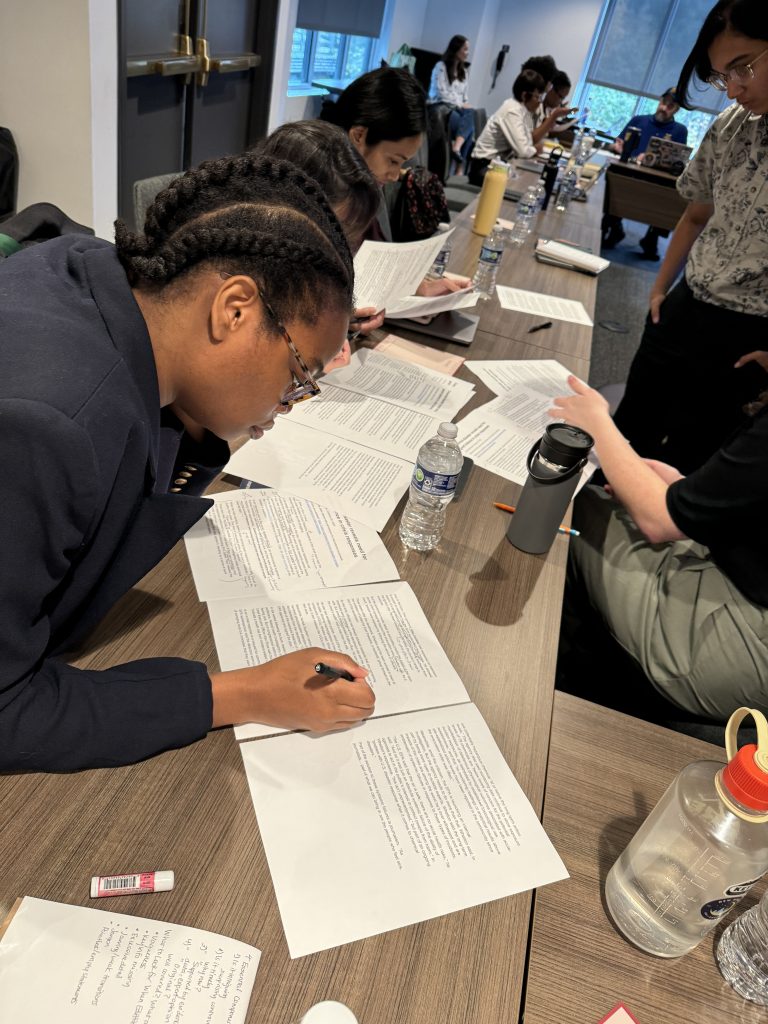
Hands-on: Every workshop puts learning into practice. Participants analyze real examples, practice new approaches, work through challenges, and receive expert guidance and feedback.
Customized: We tailor trainings to the people in the room, from newsroom teams, freelance journalists, and students to researchers, universities, and scientific organizations.
Built for Lasting Impact: Participants leave each workshop with practical tools they can return to in their daily work, including templates, checklists, interactive guides, annotated stories, and curated TON resources, so learning can continue well beyond one workshop.
Explore Our Trainings
Trainings for Journalists & Newsrooms
Every story is a science story.
Journalists on every beat are increasingly called on to interpret scientific evidence, data, and expertise—often without specialized training. From health and the environment to housing, education, transportation, and public safety, the ability to vet claims, interview experts, and communicate complex information is essential to strong reporting that holds power to account.
The Open Notebook’s customizable trainings take the intimidation out of bringing scientific evidence into stories, helping journalists and editors find and evaluate evidence, identify credible expert sources, navigate uncertainty and competing claims, and bring scientific context into stories accurately, clearly, and with nuance.
Our workshops serve journalists at every level of experience, from students to seasoned reporters, and on every beat, from local and general-assignment journalists to specialized science writers and editors seeking to deepen their craft. Trainings can be tailored to participants’ experience, beats, newsroom priorities, and professional development goals.
Our training programs help journalists build these skills and put them into practice. We use real-world examples, hands-on exercises, discussion, and expert feedback to help journalists produce rigorous reporting that better serves their communities.
Training Modules
The modules below are highly flexible. They can be offered as standalone workshops or combined into a multi-session training program. We work with partners to select and customize the topics most relevant to their needs.
Bringing Scientific Evidence into Any Beat
This immersive training helps local, general-assignment, and beat reporters confidently identify and incorporate scientific evidence into their coverage.
Through hands-on exercises and real-world examples, participants develop practical skills for:
- Finding and reading scientific research
- Understanding how research is conducted, funded, and published
- Finding and interviewing credible experts
- Evaluating evidence and competing claims
- Spotting pseudoscience, hype, and misinformation
- Reporting on risk, uncertainty, and controversy
- Identifying the science underlying policy and community issues
- Bringing scientific context into stories on any beat
Participants leave with practical resources they can immediately apply to their reporting.
Science Reporting Navigator: Guided Training
The Open Notebook’s Science Reporting Navigator is an interactive, on-demand tool, developed in partnership with the Reynolds Journalism Institute, that helps journalists find, evaluate, and incorporate scientific evidence into stories on any beat, even on deadline.
In this hands-on workshop, reporters and editors learn how to use the Navigator to tackle real reporting situations, from breaking news and new research to policy debates and ongoing community issues.
Participants explore practical approaches to:
- Finding and accessing scientific research
- Accessing and evaluating scientific papers
- Finding and interviewing expert sources
- Deciphering statistics
- Evaluating scientific claims and spotting pseudoscience
- Reporting on controversial or politicized science
- Finding the science dimensions in any story
The Navigator also provides ready-to-use resources—including templates for reaching expert sources, interview question guides, and scenario-based learning paths—that journalists can continue using long after the training ends.
Job Simulation: Reporting on Research
This experiential training puts participants in the role of a science journalist reporting on research. Through a realistic job simulation, participants practice assessing whether a study is newsworthy, identifying compelling story angles, and preparing for interviews that uncover context, significance, and limitations. They learn to evaluate the strength of the evidence, ask critical questions, and translate complex findings into engaging stories for general audiences.
The goal is to give participants a practical framework for approaching research with the rigor, curiosity, and critical thinking of an experienced science journalist.
Core Science Journalism Skills
Our flexible suite of craft-focused workshops helps reporters and editors strengthen the skills behind strong evidence-based journalism.
Topics can include:
- Honing sharp angles and strong pitches. We’ll dial in on how to clarify your ideas, craft solid reporting plans, and connect meaningfully with editors to produce a successful story.
- Interviewing tactics and source dynamics. Secure time with in-demand experts and cultivate trust so sources feel comfortable sharing emotional depth alongside technical data. You’ll also learn tactical approaches for drawing out candid responses and working around reticent sources and institutions.
- Structuring stories for clarity and impact. Regardless of what kinds of stories you cover, learn practical and repeatable tools to establish context, find the right flow, and leave audiences with meaningful takeaways.
- Elevating narrative craft. Learn how to tell engaging stories across all word counts, bringing characters to life on the page, moving between concrete details and big-picture ideas, shedding sentence “deadweight” to improve clarity and flow, and using scenic action to keep readers glued to your stories right to the end.
- Reporting on individual studies. For new science reporters or those who don’t normally cover science, getting comfortable with the study story will unlock your capacity to communicate science clearly and dive into the stories behind new research.
- Making sense of statistics. In this workshop, you’ll learn the basics of data journalism, finding the story behind the numbers and sharing what a dataset means with audiences.
- Covering risk and uncertainty. Learn how to guide audiences through shifting science and provide nuance without losing reader engagement. You’ll gain frameworks for explaining scientific uncertainty clearly and accurately when data is incomplete or evolving.
- Synthesizing ideas and writing with authority. This workshop will help you move past excessive citation and over-quoting to write with authority grounded in evidence. We’ll practice homing in on your story’s central question, curating backstory, and navigating differing expert perspectives to steer stories to meaningful, satisfying resolutions.
- Reporting on scientific misconduct. Discover practical strategies for covering research integrity, spotting investigative leads, and navigating complex ethical conflicts. We’ll cover essential methods for protecting vulnerable sources and managing sensitive materials, with tailored advice for newsroom staffers and freelancers.
- Deconstructing great stories. Drawing on annotations and behind-the-scenes insights from The Best Science Stories and How They Work, this workshop uses active close reading to make the hidden architecture of great storytelling visible. By reverse-engineering published pieces and dissecting real-world reporting and writing choices, you’ll sharpen your critical eye and expand your narrative toolkit.
- Developing or deepening a science beat. Whether you hope to work with patient sources for health stories or take steps into field reporting as an environmental journalist, we’ll help you understand the fundamentals of a given scientific beat and empower you to cover it confidently.
Sessions can be combined or customized around the needs and experience of participants.
The Craft of Editing
Strong journalism depends on strong editing—but journalists have few opportunities to learn how to edit complex, evidence-rich stories. To help fill this critical gap, our customizable, hands-on training helps working and aspiring editors develop stronger editorial instincts and gives writers practical strategies for becoming better self-editors. Through proven frameworks, real-world examples, exercises, and expert guidance, participants learn how to diagnose what a story needs and make purposeful editorial decisions at every stage of the process.
Core topics may include:
- Developing the skills and mindset of an effective editor
- Sharpening story ideas and building stronger reporting plans
- Prioritizing the editing and self-editing process
- Using The Open Notebook’s Editing Forensics™ approach to evaluate stories at the conceptual, structural, and stylistic levels
- Reverse-outlining drafts and published stories to examine structure, identify gaps, and strengthen focus and flow
- Giving clear, constructive feedback and building collaborative editor-writer relationships
Build a Training Around Your Needs
Every newsroom and organization is different. Trainings can be offered virtually or in person, for small cohorts or larger groups, and as standalone workshops or multi-session programs.
Programs can also include:
- Small-group coaching or breakout sessions
- Follow-up virtual office hours
- Beat-specific resource collections
- Annotated sample stories
- Consultations with newsroom leadership
Not sure which training is right for your team? Tell us your budget and goals and we’ll work with you to design an approach that fits.
Trainings for Scientists & Science Communicators
Turn complex research into clear, compelling stories for any audience.
The work scientists do has never been more central to public life—and the ability to communicate that work well has never been more important. Whether they’re writing for the public, teaching students, preparing grant materials, presenting to policymakers, collaborating with journalists, or engaging with communities, researchers and institutional communicators benefit from strong communication skills.
The Open Notebook brings the expertise of experienced science journalists and editors directly to researchers through hands-on training in clear, engaging science communication.
Designed for groups from universities, research institutions, scientific societies, funders, and other organizations, our workshops help scientists and institutional science communicators tell the stories in their research, explain complexity and uncertainty, connect with different audiences, and communicate their work with greater confidence and impact.
Training Modules
Each module can be delivered as a standalone session or combined into a multi-session program. Workshops can be offered virtually or in person, and we tailor each one to the goals, expertise level, and disciplinary background of our partners.
Working with Journalists
Finding Compelling Stories in Your Research
Tuning Your Story for Different Audiences
Communicating Science as a Human Narrative
Communicating Responsibly about Uncertainty and Risk
Job Simulation: Reporting on Research
A Training Designed around Your Goals
No two organizations have exactly the same needs. We work with partners to develop workshops and programs around their audiences, priorities, and goals.
Interested in bringing The Open Notebook to your organization?
Training Partners
We’re proud to have delivered trainings and workshops in partnership with organizations including: