

Maximiliano Manzoni’s career as an investigative climate journalist traces back to an Internet café in Paraguay in the early 2010s. Working at the café to support himself, Manzoni would spend his breaks taking advantage of the Internet access to teach himself the craft of journalism. Even in these early days, he wondered how to connect meaningfully with readers.
In 2016, he cofounded El Surti, a digital outlet, at which he experimented with different digital storytelling techniques, ranging from Facebook and Twitter threads to Instagram carousels, podcasts, YouTube, and Discord. He eventually brought what he learned there to Consenso, a subscription-based newsletter that he founded in 2024.
Consenso covers climate, justice, and disinformation in Paraguay and across South America. Manzoni says that adopting a newsletter format allows him to be more directly accountable to and connected with readers, and less dependent on social media algorithms and external funding. This is especially important, he argues, for journalism on climate and justice because it challenges powerful political and economic interests. “I don’t want to practice journalism if my journalism is not going to be subject to the scrutiny of my readers before that of any other organization.”
Since its founding, Consenso has published investigations on the influence of agribusiness corporations on climate policies in South America and the granting of lithium exploration permits in protected Indigenous territories. Last year, Manzoni teamed up with a data journalist and web developer to tackle an ambitious project investigating the toll of climate change on public schools.
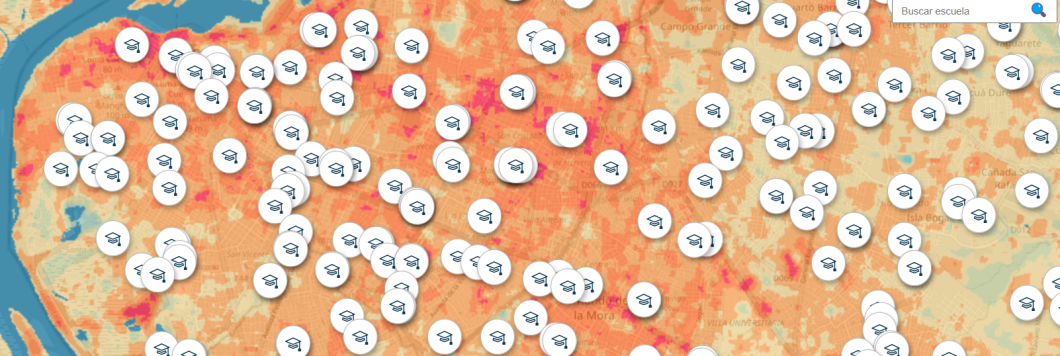
Combining satellite imagery, government data, and geospatial analysis, the team tracked the effects of extreme heat on schools in Asunción, Paraguay’s capital, and Central, its most populated region. They showed that 95 percent of 759 schools that lacked water or adequate ventilation were located in urban heat islands, exposing more than 115,000 students to extreme temperatures and affecting their health and well-being. The investigation prompted national media coverage and a formal public hearing in Paraguay’s Chamber of Deputies.
Xilena Pinedo caught up with Manzoni to talk about building climate investigations from scarce data, translating them into accessible stories, and making climate change resonate with local readers. This interview was originally conducted in Spanish. It has been translated and edited for length and clarity.
What led you to launch Consenso?
When I left El Surti, in the midst of the broader media [funding] crisis, I decided to keep doing journalism. I already had nearly a decade of experience, more than half of which was spent doing investigative climate journalism. I believed there was still a need for it and an audience for it in Paraguay and in South America in general. But what interested me was changing the relationship with audiences. In other words, [I wanted to rely] as little as possible on the algorithm because it is a passive flow. Creating a newsletter seemed like the natural step—to have a media outlet that invited people to step away from scrolling, which doesn’t necessarily allow for the depth and complexity of the necessary conversations related to climate.
Can you describe your relationship with your readers?
People who pay for Consenso do so for two reasons. One is because they read an article they found interesting and subscribed specifically for that article, which carries the added weight of, ‘This is the kind of coverage people want.’ Or they pay [because they believe in] Consenso’s mission.
In the long run, rather than a particular piece of coverage, what matters is direct conversation with our readers. I send them emails constantly, explain our methodology, [and] try to have one-on-one conversations. [They] may agree or disagree with me, but what we have to agree on is the need for something like this to exist. Everything else we can discuss. [That’s] why we call the platform “Consenso” (“consensus” in Spanish).
How did this ongoing commitment to your readers influence your decision to investigate the impact of extreme heat on schools?
I’d accessed a couple of heat island maps produced by the Inter-American Development Bank in collaboration with the Tecnológico de Monterrey, covering around 500 cities in Latin America. In other countries, governments were using these maps to inform public policy decisions. In Paraguay, they weren’t being used, so I said, “Well, if the government isn’t going to use them, we’ll use them ourselves.”
We could’ve simply said, “These are the five areas with the most heat islands,” but we felt we needed to translate this into people’s everyday lives. For us, it was important that climate be added as a perspective to other discussions taking place in Paraguay. One of these discussions, which has been going on for many years, relates to the state of school infrastructure [such as the lack of adequate toilets, air conditioners, fans, or drinking water].
How did you use data to connect those infrastructure issues to extreme heat?
We carried out a crowdsourcing exercise [that started with] a database of infrastructure needs from the [national] Ministry of Education. This information was based on what teachers and parents had reported. We had to verify it and, in many cases, find out where the schools were, because the ministry itself didn’t have the locations. Verification involved checking if [the schools] existed on Google Maps, seeing if their locations were listed on their Facebook pages, joining WhatsApp and Facebook groups for students, alumni, and parents to ask, and sometimes calling teachers and parents. It was a combination of various data collection methods.
Then there was the challenge of how to locate these schools within the heat map. We were working with over 1,200 schools. It was absolutely impossible to [analyze each school] one by one.
How did you tackle that challenge?
We came up with the idea of creating a [computer] program that would allow us, first, to locate [schools] and, second, to quantify their [heat] risk. [We called it] “Hakusito,” which [comes from the word “haku” that] means heat in Guaraní [an Indigenous and official language in Paraguay]. It’s a program we designed and developed [with funding from our] subscribers, which allows us to identify any point of interest on a map simply by entering the coordinates and the color [indicating different levels of severity]. I ask Hakusito: “Of all these schools, tell me which ones are in the red zone?” And that’s how we found out how many schools that have problems with access to water, electricity, or fans are in high, medium, or intermediate heat-risk zones in a particular city. It’s a technological development that we will be able to use in the future not only for heat islands but for any map that uses colors, such as deforestation maps.
Is that why it was necessary to do this story through a collaboration?
Yes. When we realized this was going to be a huge project with a significant impact, we used Consenso subscription money to pay a journalist to carry out the data analysis for us.
We also paid a web developer to build Hakusito according to our requirements. Nicolás Granada, who is a photographer and a regular contributor to Consenso, provided photographic material. And then we asked an academic to review our entire methodology to see if there were any weaknesses. That review was also paid.
Can you explain why you decided to feature the interactive map as the primary story element rather than a narrative?
One of the elements we’ve developed at Consenso in terms of format is maps, because that’s something I know how to do. Since I started working in environmental journalism on rural issues, one of the first things I had to learn was how to analyze export [data] in order to conduct investigations on, for example, soy, leather, or beef. So, geographic information systems—or, more generally, open-source analysis tools—were the first things I had to adopt.
That ended up becoming one of Consenso’s signature formats. We do a lot of mapping and data analysis. In this particular case, it was because we had that map available and also because maps, in general, provide an aerial view of a problem that you would otherwise only see at eye level. They allow you to understand the scope of the problem in a way that transcends personal subjectivity.
Other national media outlets with a huge reach reported on your findings. How did you feel when that happened?
I think it confirmed that the angle we’d chosen was the right one; we brought a fresh perspective to an issue that other media outlets had already been covering.
It also had a lot to do with our publishing philosophy. All our information is public. We sit down with journalists from other media outlets to explain our methodology and, above all, we don’t just focus on schools and their infrastructure problems but also on what this means for the health of children and teenagers.
And then there’s the timing. [One detail] of no small importance is that we published the report during the week that school starts.
Do you think this coverage contributed to the Paraguayan Congress subsequently calling a public hearing to present the findings?
Yes, definitely, because even if [people] hadn’t heard of Consenso, the story was broadcast on television, and two minutes of television coverage has a huge impact. That was when we were contacted by the office of one of the members of the Parliamentary Front for Children and Adolescents of the Chamber of Deputies. She said to me, “And what would you like to do about this?” And I said, “Let’s hold a public hearing.”
We invited all the organizations involved in the issue: parents’ associations, four students’ associations, representatives from six local councils, the Governor’s Office, the Ministry of Education and Science, the Ministry of Children and Adolescents, the Ministry of the Environment and Sustainable Development, the Red Cross, and, of course, senators from different political parties.
How did the hearing amplify the story’s impact?
It provided a space for discussion about the reasons why this is happening. It also facilitated a direct exchange of views on corruption linked to school construction within many local government jurisdictions. But above all, it sparked a conversation within the institutions and organizations present to the extent that the national director for climate change ended up acknowledging that the public hearing was a milestone in the history of climate policy. Nothing like it had been held [to examine] the impact of climate change in a specific place or sector, such as education.
And, at the same time, it helped me to tell my subscribers, “This is why it’s important that we do this kind of journalism,” because it enables conversations that didn’t exist before.
Was there any follow-up coverage?
Yes, we’ve worked on two stories since then. One of them looked at why some of the schools we identified had infrastructure problems. Essentially, the money was there, but as the municipality [hadn’t accounted for previous spending], the funds were frozen. [And] now we want to look at why there are so many heat islands in Asunción and Central.
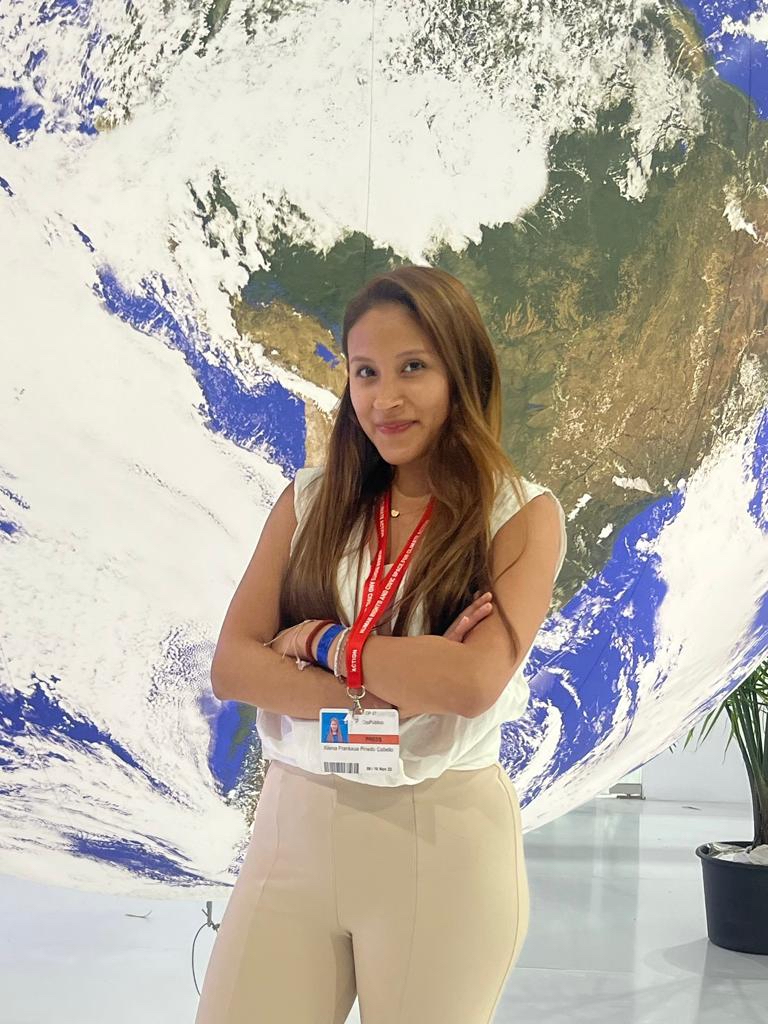
Xilena Pinedo is a Peruvian science journalist covering health, environmental issues, and climate change in Latin America. Her reporting focuses on environmental justice and the relationship between scientific research, public policy, and Indigenous knowledge. Follow her on X and Instagram.