
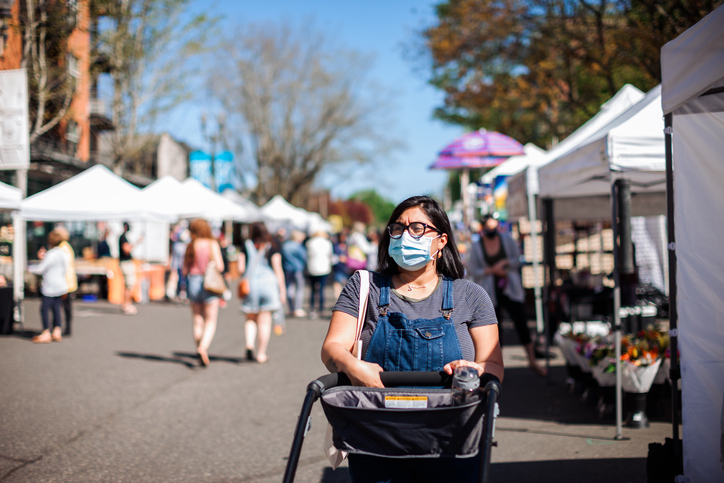
Like everyone else during the early days of the COVID-19 pandemic, Arizona-based journalist Maritza L. Félix was glued to her television and phone—there wasn’t much else to do. That’s when she noticed her mother, who lives in Mexico, posting about the infectious disease on WhatsApp. Concerningly, a lot of the information she was sharing, and that which Félix found in other WhatsApp groups, was false. As Félix started fact-checking posts about COVID-19, she realized that existing efforts to debunk false information for Spanish-speaking audiences on platforms such as WhatsApp, Facebook, TikTok, and YouTube were sorely lacking. The need for factual information in Spanish was urgent, she says.
The rampant spread of mis- and disinformation, in tandem with the virus itself, led Félix to found Conecta Arizona, a news outlet targeting Spanish speakers on the borderlands, in May 2020. To address her audience’s pressing questions, Félix says she often turns to explainers—stories crafted to distill a complicated topic into more graspable material. Conecta Arizona shares explainers as graphics or text-based posts via WhatsApp, Facebook, and Instagram, as well as articles posted on the outlet’s website. The simplified format of an explainer allows Félix and her team to get clear, concise information into their readers’ hands quickly. In the first year after the outlet debuted, Félix and another part-time reporter debunked more than 300 myths about COVID-19, such as false claims that mosquitos can transmit the virus or that using hand sanitizer is better than using soap.
Explainers have long been used in science reporting to help audiences make sense of their world. Though these stories often appear as concise articles, in which a reporter poses and answers common questions their audience may have about a topic, they can also take the form of TikTok videos, sidebars, social media threads, data graphics, or narrative features. National news outlets such as Vox, The Upshot from The New York Times, and Bloomberg’s QuickTake publish explainers as a regular part of their coverage.
Explainers are also a powerful tool in the hands of local reporters, especially when they need to tackle a tricky science topic or interpret data in a digestible manner. In fact, the first winner of the Pulitzer Prize in Explanatory Journalism in 1985 was the late reporter Jon Franklin of The Baltimore Evening Sun, for an explainer series on the science of molecular psychiatry. Explainers can help local journalists break down the science behind an issue important to their audience, such as water quality, public health concerns, or the changing climate. At the same time, writing explainers can be an accessible way for local reporters without a science background to begin building their science-reporting chops.
Finding Fodder for Science Explainers
You can find ideas for local science explainers in almost any area of your community. Try searching through community newsletters and social media groups, reading flyers posted in your neighborhood, and attending local town halls or other municipal meetings. If there’s a topic that a lot of people seem to be talking—or arguing—about, or if there’s an unanswered question floating around, your ears should perk up.
Even national coverage can inspire stories relevant for your local audience. For science reporter Helina Selemon, an explainer idea on her COVID-19 beat at the New York Amsterdam News came from reading a STAT op-ed about missing COVID-19 race and ethnicity data. Selemon wondered why that data was missing—a question that led her on a months-long reporting journey. Her resulting May 2023 explanatory feature describes how overwhelmed and flawed data-gathering systems combined with community mistrust of medical institutions led to missing race and ethnicity data. “I just thought this kind of in-depth quality reporting is something that the community deserves more of,” says Selemon, whose outlet primarily targets Black New Yorkers. “This is context that we often don’t get into in other quick explainers or news stories.”
The straightforward, sometimes formulaic, nature of explainers helps break unfamiliar science topics down into more digestible bits.
In this way, Selemon says, explainers are a great way to get past “this happened today’’ reporting. While covering what people need to know now is useful, there’s also an opportunity for explainers to go beyond an acute moment and zoom out. For Selemon’s missing-COVID-19-data explainer, that meant looking ahead to what would happen to data collection and reporting after the U.S. public health emergency expired.
Journalists can also find explainer ideas by cataloging questions their sources pose during reporting for other stories. “It’s really kind of cluing in to yourself and also the folks you talk to about what they’re wondering about the news,” says CalMatters water reporter Rachel Becker. While covering drought conditions in California as part of her beat since 2021, Becker noticed that multiple sources were asking whether the state had enough water. Becker pooled these questions and wrote a November 2022 explainer about solutions to boost California’s water supply. This type of story was important to readers at CalMatters, which covers California policy and politics, she says.
Becker says she also tries to anticipate questions her audience may have about a news event. To do this, she suggests adding a historical context to explainers, applying a ‘“how did we get here?” frame before diving into the issue at hand. “It’s kind of thinking about what those next questions are, once you hear about the news,” she says.
“Contextualization is key to making explainers work,” says science writer Alex Ip, founder and editor-in-chief of The Xylom, a nonprofit news outlet that covers how science shapes local communities. When written as second-day stories, explainers put news events in greater context to help audiences understand them more deeply. For example, after seeing news coverage in larger outlets about a City of Atlanta plan to develop land for a training facility for law enforcement and other personnel, Ip wrote a February 2023 explainer debunking the city’s claims that the project would come at minimal environmental cost. He used Google Street View and public county zoning data to produce a fact-check of a city press release about the project. (The city later removed the press release in question from its website.)
Publishing explainers might lead to future story ideas, too. Since writing his explainer, Ip says sources have reached out to him with tips. Reporters can also use explainers as the building blocks of future reporting that can be more in-depth or narrative, he says.
Using Explainers to Decode Science
Explainers can help connect local news consumers with science topics that might otherwise feel intimidating. But reporters themselves don’t need to have a background in science reporting to produce informative explainers. In fact, the exercise of writing explainers can be a great way for local reporters to strengthen their science-writing muscles.
The straightforward, sometimes formulaic, nature of explainers helps break unfamiliar science topics down into more digestible bits. They can help reporters quickly get up to speed on a topic, especially if they’re thrown into covering a breaking story. Selemon has a bachelor’s degree in microbiology but says she still gets confused about complex topics in other scientific fields. Journalists can use the template of an explainer to guide their interviews with sources, as they ask the most basic questions on a topic and build up from there. “Be ready for it to be an education for yourself,” Selemon says.
When written well, science explainers give audiences clear, concise information about issues that affect their daily lives.
When navigating new or particularly tricky topics for an explainer, good sources are key. Félix hadn’t covered health and science extensively before she started debunking COVID-19 myths for her audience at Conecta Arizona. So, to help her and her audience understand the quickly unfolding pandemic, Félix solicited Spanish-speaking doctors, mental health experts, and a representative from the CDC for Q&As on her outlet’s radio show and WhatsApp explainers.
It’s also important to find sources with the right expertise for your story, says Tori Espensen, scientific outreach manager at the nonprofit SciLine, which supports journalists looking to cover science in their work. “You can’t go to the same epidemiologist for every public health story,” she says. To narrow your search, Espensen recommends searching databases such as Google Scholar with keywords related to your specific story. Once you find a relevant paper, you can reach out to its authors. Try connecting with public information officers at local universities, and ask them to recommend a faculty member with relevant expertise. (Reporters looking for sources—on deadline or not—can also take advantage of SciLine’s expert matching service.)
If you get tripped up while drafting your explainer or trying to decipher your interview notes, don’t hesitate to ask your sources follow-up questions. And ask them to rephrase if something they say isn’t clear—either on the spot or once you return to your notes. Reporters shouldn’t feel bad about asking scientists to explain something in simpler terms in order for the reader to understand, Espensen says. “A scientist is not going to judge you for not knowing these things.” Asking clarification questions will not only make you feel more confident about the facts in your story; it will also make scientists feel more comfortable and want to work with you in the future.
Constructing an Effective Explainer
When written well, science explainers give audiences clear, concise information about issues that affect their daily lives. “The goal of an explainer is for a person who’s never learned about it to understand something enough so that they can make decisions about it,” Ip says.
The key is striking the balance of communicating what your audience needs to know without muddling the facts with unnecessary details. Finding the right structure for your explainer can help you accomplish that balance. For Selemon, a feature approach gave her the space she needed to delve into the complex web of COVID-19 data collection. Still, she relied on her editor to help her be rigorous about what facts needed to stay and what could be excised.
Figuring out what information your audience needs to make informed decisions takes staying engaged and listening to what matters most to them.
Reporters can thread links and other resources throughout their explainers, allowing readers who want to dive deeper a chance to do so without alienating those who just want the key facts. In his Atlanta training-center explainer, Ip linked to government documents and other reports that helped him refute the City of Atlanta’s claims. Showing your work also builds readers’ trust in your reporting, Ip says.
No matter their structure, explainers should have a clear takeaway that audiences can carry into their everyday lives, Selemon says. For her COVID-19 story, it was how missing data harms communities of color. To help make takeaways clear, write a sharp introduction that deftly delivers the story’s “why” to the reader. “Once you create a bridge of understanding for readers,” she says, “people feel equipped. They feel empowered with the information.”
Figuring out what information your audience needs to make informed decisions takes staying engaged and listening to what matters most to them. Through being attentive and responsive to her community, Félix says she’s been able to discern the main concerns and questions her audience has about COVID-19 and other issues. “We’re having conversations quite often,” she says. That means always going back to your community and asking questions such as, “What do you need to know?” and “What did you wish you knew before this?” Through these conversations, she says, local journalists can help their audiences better understand the science within their corner of the world.
Roxanne Scott is a freelance journalist in Queens, New York. She’s worked in newsrooms for more than seven years, most recently as a senior producer on the investigations desk at Futuro Media. Prior to that, she was a reporter at NPR affiliates in Atlanta and Louisville, Kentucky. Find her on X @whosworld.