
Science journalists often learn the tricks of the trade by trial and error. But here at The Open Notebook, we firmly believe the basics of covering science, and covering it well, can also be taught. And we’ve organized some of TON’s resources into a sample syllabus to help you get started—whether you’re an instructor putting together a “Science Journalism 101” curriculum, or a freelancer looking to firm up your foundation in the core skills of the craft.
Organized into a dozen modules corresponding roughly to a 12-week course, these readings, discussion questions, and assignments cover many of the topics you might find in an introductory science journalism class—from pitching stories and conducting interviews to writing features and bringing narrative into your storytelling. (Many of the readings also appear in The Craft of Science Writing, so if you’re a teacher, you might consider assigning this book to your students.)
Use the syllabus in whatever way makes sense for you: Follow it to a tee; sample just the bits that entice you most; or simply use it as inspiration for building your own course of study. Whatever the case, we hope you’ll have fun with it, and that you—or your students—will come away feeling equipped to put these lessons into practice.
Note: Articles that are included in The Craft of Science Writing are indicated in red.
Modules in This Sample Syllabus
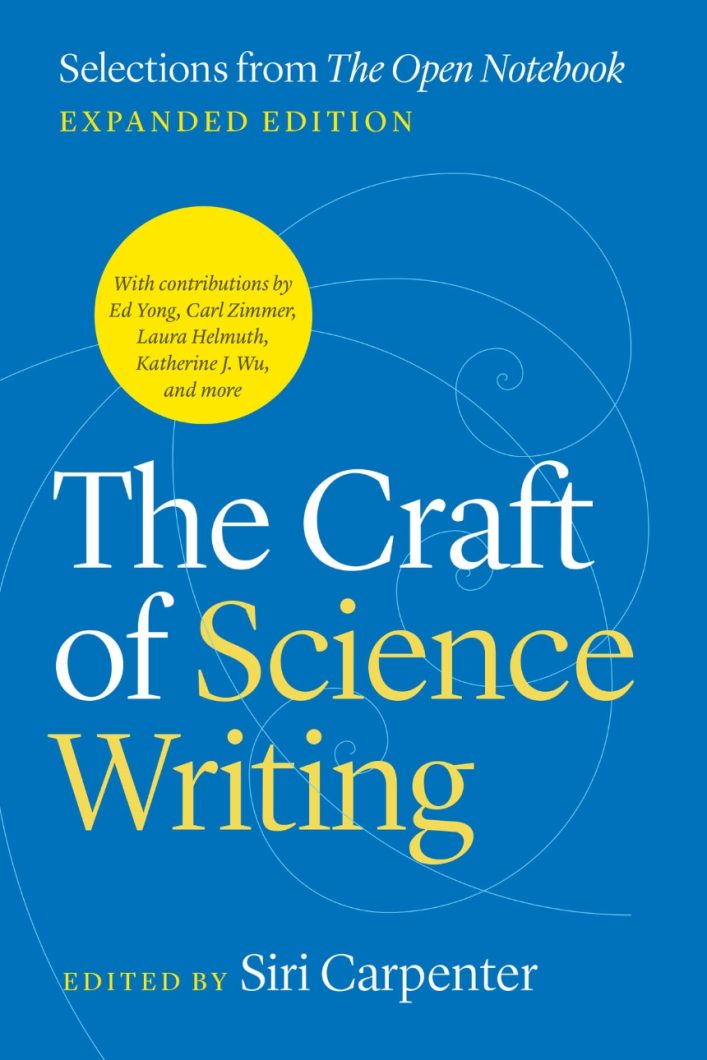
Order The Craft of Science Writing wherever books are sold.
Many thanks to Ashley Smart for extensive assistance in the creation of this sample syllabus.
MODULE 1
Finding Story Angles
Suggested TON Readings
Additional Resource
Science Journalism Master Class: How to Find an Angle for Any Science Story
Angles are the secret sauce of journalism. Identifying them can be tricky even for the most experienced science reporters. During each lesson in this course, we present a concrete, achievable strategy for identifying, sharpening, and vetting story angles. By the end of the course, students will have delved into a topic that interests them and should have pinpointed a novel, pitchable angle.

Discussion Questions
- In “Sharpening Ideas: From Topic to Story,” Dan Ferber notes that journalists can elevate a pitch by proposing not just to explain some fascinating nugget of science, but to tell a story, with an angle and a compelling narrative. In your view, what differentiates a topic from a story? Can you point to real-world examples of both?
- In “Following a Story as It Unfurls,” Jane C. Hu writes that “following a rewarding story may require a healthy dose of persistence—and patience” and gives a few examples of reasons a story might not have all the right pieces: a key research paper may be slow to publish, a main character may be difficult to track down, the right news peg may not have surfaced yet. Can you think of other “speed bumps” that might cause a story to take longer than anticipated to develop? How would you work around them?
Possible Assignments
- In “Is This a Story? How to Evaluate Your Ideas Before You Pitch,” Mallory Pickett explains that some story ideas may be tailor made to fit specific formats. An idea that’s not quite right for a news story may be well cast as a Q&A, infographic, or profile. Take a few moments to think of something science-related that you’d like to write about, and use the tips and flow chart in Pickett’s piece to decide what, if any, format your story idea should take. Be sure to explain your reasoning.
- In Kate Morgan’s “Finding the Science in Any Story,” journalist Cari Rom Nazeer asserts that there’s at least a little bit of science in everything people “do or touch in our day-to-day lives.” Put that notion to the test: Browse a general interest newspaper or magazine, find a story on a non-science topic, and think of a science angle you could explore. Using search platforms such as Google or Google Scholar, find at least one scientist and one research paper that might offer useful background for your story.
MODULE 2
Pitching Stories
Suggested TON Readings
- “Picking a Publication to Pitch” *
- “The Pitch as Hypothesis: How Stories Evolve through Reporting”
- “What Makes a Good Pitch? Annotations from the TON Pitch Database,” from The Craft of Science Writing (does not appear online)
* Note: The science media landscape changes rapidly, and some media outlets mentioned in “Picking a Publication to Pitch” may no longer be accepting pitches (or may no longer exist). For a more up-to-date list of media outlets to pitch, we recommend this resource page developed by journalist Robin Lloyd.
Additional Resources
Science Journalism Master Class: How to Pitch Science Stories That Sell
Students are encouraged to begin this course with an idea for a story they want to produce. By the end of the course, they will have written a compelling, tightly constructed pitch targeted to a specific publication that possesses all the elements necessary to convince an editor to make the assignment.

To tell a compelling story to readers, you first need to sell your idea to an editor. The Open Notebook‘s Pitch Database contains hundreds of successful story pitches to a wide range of publications. Each pitch is accompanied by a link to the resulting published story.
Discussion Questions
- In “The Pitch as Hypothesis: How Stories Evolve through Reporting,” Pedro Márquez-Zacarías presents several reasons a journalist might decide to abandon a story idea: The science may not be as new or innovative as they originally thought, a source’s claims may prove unreliable; a ride-along reporting trip may fall through. What other kinds of stumbling blocks might imperil a story idea? How could you try to work around them?
- Select and read a pitch from The Open Notebook’s Pitch Database. What new discovery or result did the writer propose to cover? What key ingredients did the pitch include, and why do you think it was successful? How would you improve it?
Possible Assignments
- Find a recent science research paper that interests you and imagine you’re going to pitch it as a news story. Use the various publication lists presented in “Picking a Publication to Pitch” to identify three publications you could pitch your story to. How would you tailor your pitch to fit each publication?
- Choose a pitch from the Open Notebook’s Pitch Database, and do a detailed annotation, using Roxanne Khamsi’s markups in “What Makes a Good Pitch? Annotations from the TON Pitch Database” as a model. Be on the lookout for descriptive language, strong verbs, compelling characters, and insightful context, as well as passages that demonstrate the writer’s experience, chops, and access to sources.
- Find a recently published research paper, and write a brief pitch for a news story. Be sure to include the essential elements of a pitch, as described in the Science Journalism Master Class, “How to Pitch Science Stories That Sell,” and tailor your pitch to the guidelines of your chosen outlet.
MODULE 3
Researching Scientific Literature
Suggested TON Readings
Discussion Questions
- In “One Size Does Not Fit All: How to Make Sense of Different Kinds of Scientific Studies,” Kelly Tyrrell describes several types of research studies—randomized controlled trials, cohort studies, modeling studies, among others—and outlines their strengths and weaknesses. Find a recent research paper using Google scholar or another search platform. What kind of study does the paper present? How do you know?
- In “Problems with Preprints: Covering Rough-Draft Manuscripts Responsibly,” Roxanne Khamsi writes that the most central question for journalists who come across a preliminary manuscript may be “whether or not to even cover a preprint in the first place.” Imagine you’re a news editor covering fast-breaking science stories. What would be your policy for deciding when and when not to use preprint studies in news stories? How would you balance the imperative to share information with the public in a timely fashion with the need to ensure that the information is reliable?
Possible Assignments
- Find a recent scientific paper and imagine you’re preparing to write a news story about it. Mark it up following the example presented by Alexandra Witze in “How to Read a Scientific Paper,” being sure to flag jargon, difficult-to-understand paragraphs, potential sources, and important facts and ideas.
- In “Spotting Shady Statistics,” Rachel Zamzow highlights several statistical clues a journalist can look for when they’re trying to gauge the strength of a clinical trial. Find a recent paper that reports the results of a clinical trial, and provide your own assessment: Were the endpoints preregistered? Did you see evidence of p-hacking or data peeking? Was the effect size large? Did the researchers do a subgroup analysis or use a proxy for their endpoint? Based on your assessment, do you think the study’s results merit news coverage?
MODULE 4
Including Diverse Voices in Science Stories
Suggested TON Readings
Additional Resources
Discussion Questions
- In “Who Is an Expert? Broadening the Definition Strengthens Journalism,” Attabey Rodríguez Benítez writes that nontraditional experts—“such as people who bring a local frame of reference to certain issues or graduate students doing the daily work of science”—can bring important perspectives to science stories. Read a recently published, science-related news feature, and make note of the expertise of the various sources. Does the writer include both traditional and nontraditional experts? Are there nonexpert voices who were missing from the article that you feel could have brought valuable perspective?
- In “Making Your Writing and Reporting Transgender-Inclusive,” Tyler Santora writes that some trans people feel that cis journalists shouldn’t report on trans issues, because trans reporters have greater access to and rapport with sources in the trans community, and because—as journalist Tuck Woodstock put it—“there are literally hundreds of underemployed trans journalists who can get that story more accurate and more nuanced.” Arguably, this is a concern that applies to reporting on a number of marginalized communities. In your view, when, if ever, is it appropriate for a journalist to report on a marginalized community they do not belong to? And what steps can they take to ensure they report with accuracy, nuance, and sensitivity?
- In “Expanding the Geographical Borders of Your Source List,” journalist Paul Adepoju suggests that a lack of geographic representation and inclusion can result in stories that leave the public “underinformed or totally misled.” Can you think of an instance where coverage of a global science issue has been hampered by a lack of geographic inclusion? How might the narrative have been different had the sourcing been more inclusive?
Possible Assignments
- The story “Covering Indigenous Communities with Respect and Sensitivity,” includes a sidebar highlighting four stories that author Debra Utacia Krol identified as models of coverage of Indigenous communities (“Examples of Best Practices in Covering TEK and Western Science”). Select one of those stories to read. What stands out to you about the story’s sourcing, terminology, and handling of Indigenous issues? Do you notice practices that you would adopt in your own approach to writing about Indigenous or other marginalized communities?
- Choose a recently published scientific paper and imagine you’re preparing to write a feature story about it. Prepare a roster of potential sources, using tips and tools provided in this module to aim for diversity of sourcing along multiple dimensions. Discuss the rationale behind your choices.
MODULE 5
Finding and Interviewing Sources
Suggested TON Readings
- “Building a Roster of Go-To Sources”
- “The Art of Crafting Effective Interview Questions”
- “How to Steer an Interview So You Get What You Need”
- “Come Again? How to Steer Scientist Sources Away from Jargon”
- “How to Conduct Difficult Interviews”
- “Interviewing for Career-Spanning Profiles”
- “Interviewing Sources about Traumatic Experiences”
Additional Resource
Science Journalism Master Class: How to Excel at Interviewing
This master class will take you inside other journalists’ interview process. You’ll find out how to strategize the number and kinds of sources to contact. We’ll discuss how to find people to talk with and how to prepare a tight, well-balanced set of open-ended questions, then improvise new ones on the fly. And you’ll get insights into the delicate business of steering the interview without overdetermining the outcome.

Discussion Questions
- In “Building a Roster of Go-To Sources,” Katherine Wu writes that the all-important line between being friendly with, and being friends with, a go-to source can be hard to define. In the article, several journalists present examples of interactions with sources that they would and would not consider ethical. Where do you draw the line for yourself? What are three things you could do to ethically cultivate a new source, and three that you believe would cross a line?
- The readings in this module describe strategies for conducting interviews for several types of stories, including news stories, profiles, and investigative stories. How do these strategies differ from one another? What do they have in common?
Possible Assignments
- Find a recent scientific paper that interests you, and imagine you’re going to interview the lead author. Following the advice in “The Art of Crafting Effective Interview Questions,” prepare a list of questions you would ask in the interview: Keep your questions expansive and not overly specific, and, as writer Emily Laber-Warren implores, don’t forget to include questions likely to elicit compelling quotes.
- Interview a partner about what they ate for breakfast this morning, with the goal of learning what kinds of food they like, and why. Use the techniques described in Tyler Santora’s “How to Steer an Interview So You Get What You Need” to keep the interview on track—reeling your partner back in from tangents, if need be, and asking follow-up questions when needed. Which portions of the interview did you find most challenging, and how did you handle them?
MODULE 6
Elements of Story Structure
Suggested TON Readings
Discussion Questions
- In “Good Beginnings: How to Write a Lede Your Editor—and Your Readers—Will Love,” Robin Meadows quotes John McPhee as saying that a lead “should shine like a flashlight down through the piece.” What might McPhee have meant with that metaphor, and what are some ways a writer can achieve this flashlight effect in a lede?
- In “Good Endings: How to Write a Kicker Your Editor—and Your Readers—Will Love,” Robin Meadows shares examples of kickers that circle back to the beginning, that tie everything together, and that share a writer’s personal experience. What are some other ways you commonly see science stories end? What are their benefits and drawbacks?
Possible Assignments
- In “Nailing the Nut Graf,” Tina Casagrand shares examples illustrating a few different approaches to the nut graf. Revisit a story that you enjoyed recently, and identify the nut graf. What information does it convey and which major themes does it flick at? In what ways was it effective or ineffective?
- In “Good Transitions: A Guide to Cementing Stories Together,” Amanda Mascarelli describes a few ways to transition from one paragraph to the next: the head-to-tail transition, the contrast approach, and the “but wait” approach. Select a recently published feature story and see how many of each type of transition you can identify. How effective was each transition, and why?
- Choose a feature story you admire and identify passages that present background, following the example provided by Jacqui Banaszynski in “Writing Elegant Background.” Is the background given in a single block, or is it braided into the narrative? What techniques does the writer use to keep the background clear and engaging?
MODULE 7
Covering Science News
Suggested TON Readings
Additional Resource
Science Journalism Master Class: How to Ace the Study Story
This course will teach you how to communicate research results in a way that is both accurate and entertaining, and how to apply skepticism and critical thinking to ensure you don’t oversell a study’s impact. You’ll learn to choose and vet studies, and how to prepare for interviews with scientists. You’ll also discover the six-part structure of a text-based study story, and how vivid language can bring technical topics to life.

Discussion Questions
- In “Demystifying Academic Hierarchies: Who’s Who on a Paper, and Whom Should You Interview?” Celia Ford writes about the importance of including a diverse range of sources in science stories, and states that “good journalism needs to represent the world equitably and inclusively.” In your view, are there certain kinds of stories for which a journalist must be particularly attentive to the diversity of their sourcing? Can you think of real-life cases where insufficiently diverse sourcing led to flawed stories?
- In “Ask TON: Sending Embargoed Papers for Outside Comment,” journalists express differing opinions about whether it’s okay to send a scientist an embargoed paper without an express agreement from that scientist to honor the embargo. What’s your own view, and why?
- In “Beyond the Press-Release Rat Race: Fresh Ways to Cover Science News,” editor Max Ufberg tells Julia Rosen that “there’s really always a research angle” to almost any piece of news, it’s just a matter of finding it. Take a moment to think of topics that have been trending in the news lately. Can you identify potential research or science angles for them?
Possible Assignments
- In “Is Anyone Out There? Sourcing News Stories,” Geoffrey Giller describes how a study’s references section and searches on Google Scholar can point a reporter to good secondary sources for a science news story. Choose a recent research study and imagine you’re assigned to write a quick turnaround news story about it. Identify five researchers who were not involved in the study and might make for good secondary sources.
- In “Demystifying Academic Hierarchies: Who’s Who on a Paper, and Whom Should You Interview?” Celia Ford explains that the principal investigator of a research group is often equipped to speak to the motivation and impact of their lab’s work, whereas junior scientists may be particularly helpful in addressing specific questions about a study’s methods, or the nuances of the data. Choose a recent research study, imagine you’re interviewing both the principal investigator and a junior scientist for a news story. Think of at least three questions for each source, tailored to specific expertise.
- In “Beyond the Press-Release Rat Race: Fresh Ways to Cover Science News,” editor Corey Powell explains that one way to get fresh story ideas is to “watch from the shore as the first wave of coverage rolls in,” then take stock of what’s lacking or misleading in the initial round of stories. Find a news story covering a recent research study, and propose a follow up story that explores an angle that went uncovered in the original study, or that positions the study in a broader context.
MODULE 8
Reporting and Writing Feature Articles
Suggested TON Readings
- “Synthesizing Ideas to Write with Authority”
- “The Secret to Never Writing a First Draft”
- “How to Find and Use Quotes in Science Stories”
- “Pulling It All Together: Organizing Reporting Notes,” from The Craft of Science Writing (does not appear online)
Discussion Questions
- In “Synthesizing Ideas to Write with Authority,” Julia Rosen writes that there’s a fundamental difference between a reporter giving their honest assessment on a complicated issue, and a biased writer marshalling evidence to support a predetermined view. In your view, what distinguishes authoritative from biased reporting, and how might you guard against bias in your own journalist work?
- In “The Secret to Never Writing a First Draft,” Siri Carpenter describes the fake email to an editor and the “ridiculously elaborate bullet list” as two strategies for nailing down the bones of a science story without the pressure and stress of writing a traditional first draft. Can you think of other strategies to begin distilling and organizing the key ideas of a story while “tricking your brain” into believing you’re not writing a first draft?
- “In Putting It All Together: Organizing Reporting Notes,” several journalists describe not only the organizational methods that work for them, but also organizational methods they tried and found didn’t work. What methods have you used to organize your own notes for writing? Which worked well, which didn’t, and why? How could you improve on them?
Possible Assignments
- In “Synthesizing Ideas to Write with Authority,” Julia Rosen writes that one way to achieve an authoritative voice is to trim unnecessary quotes and attributions. Choose a writing sample with five or more direct quotes. Is each quote necessary? Does it contribute something to the story that a paraphrasing of the same idea could not? Why or why not?
- In “How to Find and Use Quotes in Science Stories,” Abdullahi Tsanni talks to sources who point out that good quotes often express emotions, give opinions, or summarize, “in clear language, a significant point of the story.” Revisit the transcript of an interview you’ve conducted, as if you are working on a story. Identify passages of the transcript that could serve as good quotes, and explain why.
MODULE 9
Narrative Storytelling
Suggested TON Readings
Discussion Questions
- In “Like Being There: How Science Writers Use Sensory Detail,” Jyoti Madhusoodanan describes how metaphor can “add pop” to technical explanations. Choose a sample of your own writing, and think of 2-3 potential metaphors that might help crystallize the central idea for the reader. What do the metaphors communicate that was missing from the technical explanation? In what ways might the metaphors be confusing or distracting?
- In “Naming the Dog: The Art of Narrative Structure,” Pulitzer Prize-winning journalist Tom French is quoted as saying that most stories fall into one of five basic narrative structures: boy meets girl, there and back (a journey), us versus them, making it (transcending an obstacle), rescuing the princess from the underworld, and the Cinderella tale. What stories can you think of that fit each of these narrative structures. (They need not be science stories.) How do these story types differ structurally?
Possible Assignments
- In “How to Cultivate Narrative in Stories of All Lengths,” Marion Renault describes how active, specific, and evocative verbs can “catalyze narrative” in short pieces. Choose a sample of your own writing, highlight each verb, and see if you can think of replacement verbs that would help create a more vivid narrative.
- In “Like Being There: How Science Writers Use Sensory Detail,” Jyoti Madhusoodanan writes that “the ladder of abstraction”—with very concrete details at the bottom rung and very abstract ones at the top rung—can be useful for thinking about how sensory details can help illuminate big ideas in a story. Choose a piece of writing; identify major themes, technical concepts, and sensory details; and arrange them on a ladder of abstraction comprising at least five rungs. Discuss how the elements on the various rungs connect with and fortify one another.
- Choose a feature story that you admire and diagram its structure. Does the structure fit one of the categories described in Christie Aschwanden’s “Naming the Dog: The Art of Narrative Structure”? Does it break or maintain chronology? Discuss which aspects of the structure are effective, and which are not.
MODULE 10
Revising and Rewriting
Suggested TON Readings
Discussion Questions
- In “The First Critic Is You: Editing Your Own Work,” Tiên Nguyễn writes that “one of the fastest and most effective ways to tighten copy is to read your piece out loud.” Select a sample of your own writing and read it aloud—with a partner if you have one. What do you notice about the structure, rhythm, and pacing of your prose? Are there phrases or sentences that caused you to stumble, and how could you improve them?
- In “Jacqui Banaszynski’s Literary Forensics: A Diagnostic Tool to Improve Writing,” Christina Selby describes a handy technique that a journalist can use to improve several elements of their narrative writing—quotes, active verbs, adjectives, jargon, and nut grafs, to name a few. What element of your own writing most needs improvement? What are some of the tics and poor habits you often fall into?
- In “Surviving the Grind of Fact-Checking,” Heather Pringle writes that “the best written sources for a science story, by the way, are always primary sources, such as a researcher’s own published papers.” Other than research papers, what types of primary sources might be useful for science stories?
Possible Assignments
- Choose a piece of your own writing, and mark it up using Banaszynski’s literary forensics technique, focusing on at least two different elements of the prose. Describe the patterns you notice in your writing, and think of changes you might make to strengthen it.
- In “Surviving the Grind of Fact-Checking,” writer Heather Pringle describes a process of going through a story “with a fine-tooth comb, checking each fact against the backup material to ensure that the writer has gotten even tiny details right.” Choose a writing sample of 300-500 words, and underline every checkable fact—including names, dates, and anything else that could be considered a statement of fact. How many facts did you identify? What kinds of sources might provide backup for these statements?
MODULE 11
Journalistic Ethics and Integrity
Suggested TON Readings
Discussion Questions
- In “Navigating Conflicts of Interest,” Rachel Zamzow writes that many freelance science writers earn a living through a mix of journalistic work and institutional writing, which can pose both real and perceived conflict of interests. Imagine you write part-time for a nearby university’s college of engineering while also freelancing for journalistic outlets. What personal rules and boundaries would you adopt to avoid crossing ethical lines?
- In “How to Handle a Mistake,” Shira Feder describes a somewhat controversial practice at Slate magazine of publishing “a weekly roundup of its mistakes with names of Slate writers who made mistakes.” What are some benefits and drawbacks of publicly attributing mistakes in that manner? As a reporter, how might such a policy impact the way you do your work?
- In “Reporting on Scientific Controversy,” Pedro Márquez-Zacarías writes that it’s often useful to center stories about controversial science “not on the answers to the specific scientific problem at hand,” but on the problem’s social context—on the search for answers and the characters engaged in that search, for instance. Think of a recent scientific controversy, and try to identify social, political, or other contextual themes that would make for a good story focus.
Possible Assignments
- Find three stories, in three different publications, that were published within the past year and have correction notices. What do they have in common, and how do they differ? Which correction format is most effective, and why?
- In “Reporting on Scientific Controversy,” Pedro Márquez-Zacarías, describes the challenges of covering scientific problems for which there is no clear consensus view. Identify two journalistic news stories that reported on the same controversial story, but differently. What differences and similarities do you notice? How do differences in sourcing, structure, and the evidence presented affect the overall tone and message of the articles?
MODULE 12
Reading to Learn
Suggested TON Readings
Additional Resource
Discussion Questions
- In “How to Build a Healthy Media Diet,” Katherine Wu writes that a good media diet “needs to be healthy: balanced, well portioned, and sustainable.” What are some of the ways you could improve your own media diet? Are there categories of news—major outlets, specialty publications, newsletters, press releases, etc.—where you think you could stand to beef up your serving sizes? Are there categories you should scale back on?
- In “How to Do a Close Read,” Siri Carpenter writes that one way to sharpen one’s craft as a reporter and writer is to closely read stories that you’ve admired. Name a writer or story you admire, and describe what you like about them.
Possible Assignments
- Keep a detailed log of your media diet for one day. Which types of news media do you consume, when, and for how long? Which stories do you skim, and which do you consume in their entirety? Afterward, review your log and report on what you find: What patterns do you notice? Do you notice certain strengths or weaknesses in your diet?
- Choose a TON Storygram that intrigues you and give it a close read. Respond to two questions from each category of Siri Carpenter’s “How to Do a Close Read.”
EXTRA!
Bonus Readings and Resources
- “Nice Niche: How to Build and Keep Up with a Beat”
- “Eradicating Ableist Language Yields More Accurate and More Humane Journalism”
- “Interrogating Data: A Science Writer’s Guide to Data Journalism”
- “Feeling Like a Fraud: The Impostor Phenomenon in Science Writing”
- “The Intern’s Survival Guide”
- “How to Find Scientist Sources and Plan Interviews”
- “What to Do When a Source Asks to See Your Unpublished Copy”
- “Shedding Sentence Deadweight to Help Science Stories Soar”
- “Reading and Negotiating a Freelance Contract”